
9th Grade Students Experience a New Adaptation of The Odyssey
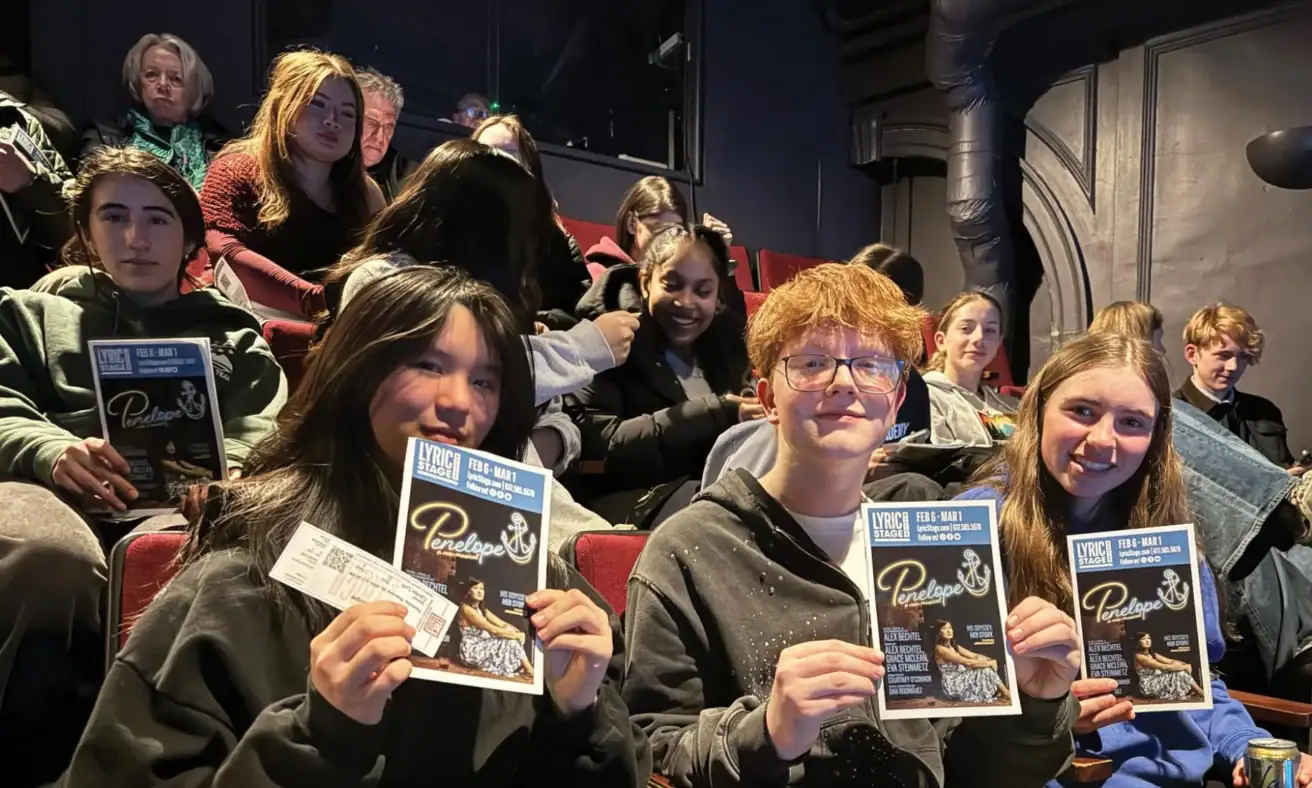
On February 26, 2026, the 9th-grade class traveled to Boston to see Penelope, a new musical inspired by The Odyssey at Lyric Stage Company. The production features music, lyrics, and arrangements by Alex Bechtel and a book by Bechtel, Grace McLean, and Eva Steinmetz.
The one-woman show, starring actress Aimee Doherty, centers on Odysseus’ wife during the 20 years she waits for his return, first from the Trojan War, then a decade lost at sea. Set on a patio in Greece, the one-act production offers an intimate, character-driven perspective on an epic story.
While Concord Academy has taught The Odyssey for decades, seeing an adaptation performed live gave students a new way to engage with the text. Attendance for all 9th graders was funded by an anonymous Boundless Campus gift, giving this year’s newest CA students an experience similar to last year’s class trip to see Kate Hamill’s The Odyssey at the American Repertory Theater.
In the original epic, Penelope appears in only a limited number of the 24 books. This musical reframes her role, emphasizing her governance of Ithaca during Odysseus’ absence. English teacher and one of the trip coordinators Laurence Vanleynseele P’22 ’28 explains, “The production shifts the focus entirely to her, making her unmistakably central, visible, and giving her a voice and point of view that students who read the poem must tease out and imaginatively reconstruct from fragments.”
The performance resonated with students. “Seeing Penelope live on stage gave me an understanding of who Penelope was and not just what role she fills in the story,” Zeke Fine ’29 says. “In the book, Penelope almost never speaks, let alone speaks about her emotions and her experience. When I saw Penelope, it enabled a sense of empathy that I did not have previously.”
In both the play and poem, Penelope manages the royal household while fending off suitors who assume Odysseus is dead. She delays remarriage by weaving and secretly unraveling a burial shroud, buying time for his return. The musical expands on this act, giving her character space to construct and deconstruct narratives and developing her humor and emotional depth through song.
“Given the origins of the story—oral culture, epics sung and performed at festivals—this choice to make the production a musical was interesting to our class,” Vanleynseele says. “The venue also created a real intimacy between the audience and the actress and the musicians behind her. It felt more like an internal, psychological portrait and not a reimagining of a set of adventures.”
The show positions Penelope as a foil to Odysseus, inviting the audience to compare their struggles and forms of heroism. “The music brought the drama that Odysseus’ adventure had to the everyday life of Penelope,” Zeke says. “Penelope is not fighting monsters and outsmarting gods, but she fights smaller battles. Because these battles are not scenes that involve a lot of action, the music creates suspense and tension.”
From witty pop songs such as “Lose My Mind” to powerful ballads such as “Us,” the score deepened the audience’s understanding of Penelope’s inner life. “The music only further enhanced my perception of Penelope as a character,” Hazel McWhinney ’29 says. “I viewed the music as the emotions she wasn’t explicitly conveying. The musicians felt like an extension of her as a character—someone playing the tune of her mind.”
For CA’s 9th-grade class, the experience of seeing Penelope underscored how classic texts evolve through interpretation, with each generation of readers bringing new voices to the fore. “Going to a performance that is an adaptation of a text brings home the notion that reading is creative,” Vanleynseele says. “You can try to understand a text in its historical context, figure out the value system it upholds or challenges, but you can also speak back to the text, enter into a dialogue with it across time and culture.”