CA Theater Brings Shakespeare in Conversation with the Age of Artificial Intelligence
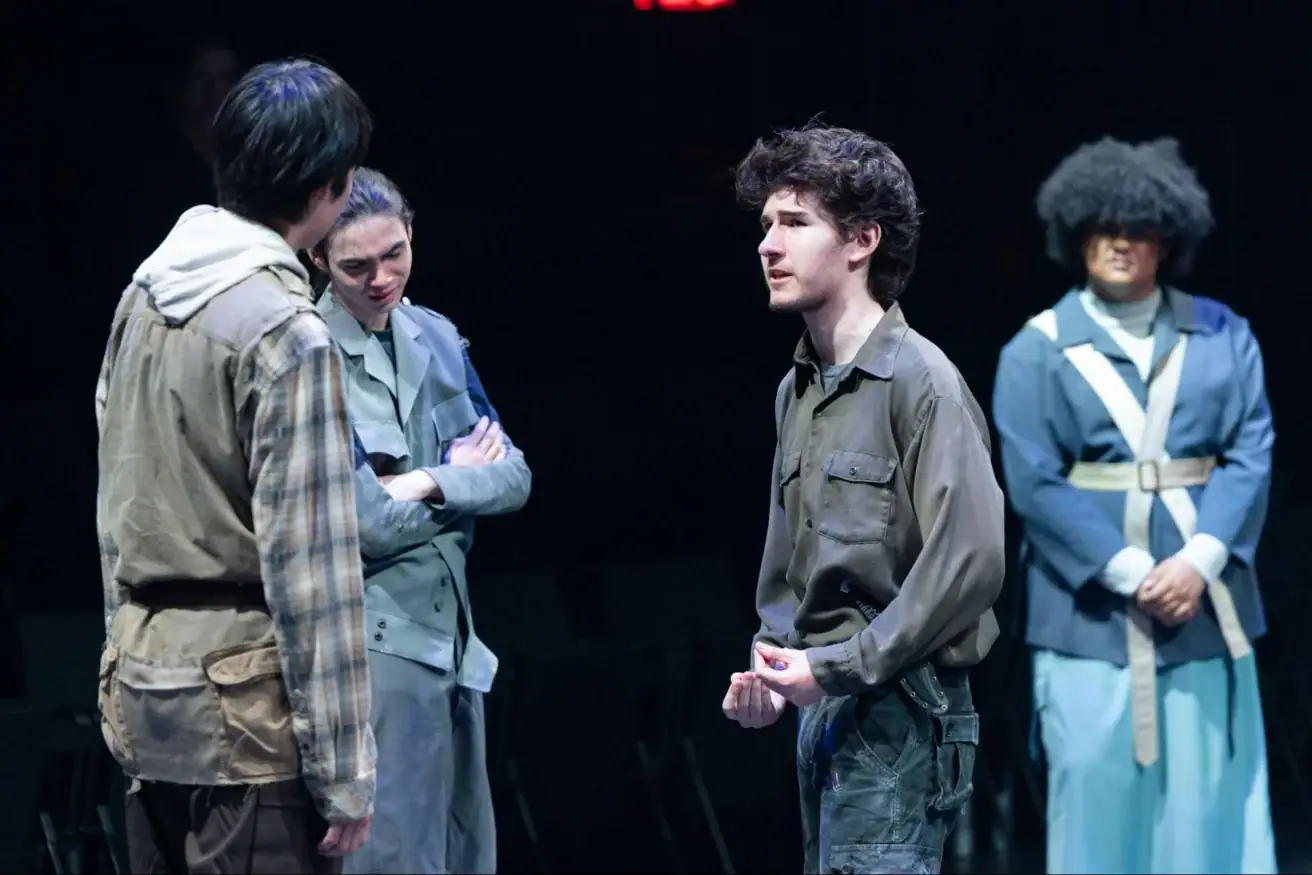
Concord Academy Performing Arts brought a futuristic edge to William Shakespeare’s Macbeth last weekend in the Hammett Ory Theater. Directed by Shelley Bolman P’27, the production reinterpreted the dangers of unchecked ambition for the digital age.
“When we choose a theater season for CA, the question we ask ourselves is, ‘Why this play now?’ Bolman shares. “It seemed to me that greed for power and artificial intelligence both resonate strongly with the current time.”
The story follows the titular character Macbeth, played by William Jiang-Fogel ’27, who becomes consumed by prophesies of his ascent to power and murders the king to seize the throne. Retaining Shakespeare’s original language, the production immersed audiences in a world where technology and human behavior are deeply intertwined.
Audiences sat on either side of a spare central stage, where a staircase and gate featured camouflage paint treatment and were entwined with wires and cable that extended across archways and pillars. Live feeds displayed the opposite side of the audience, while screens featured “Heck 8.0,” an AI system that generated prophetic outputs.
Together, the utilitarian costumes, minimal props, and stark set established a militaristic aesthetic. The unsettling, electronic sound design by music teacher Nate Tucker and his Digital Music Production students further immersed audiences in the production’s technologically driven world.
The production opened in darkness, with a flash of lightning illuminating an ensemble wearing Guy Fawkes masks, complete with white faces, stylized mustaches and beards, and mischievous grins.
Emerging from the center of the group, the Weird Sisters were revealed as the production’s witches, reimagined as analogues for predictive AI. Dressed entirely in white and wearing Fawkes-inspired makeup, the witches embodied the intersection of supernatural and computational power.
The visual references to Fawkes draw on his participation in the failed 1605 Gunpowder Plot to blow up Parliament, an event also referenced in Shakespeare’s original text. Fawkes’s image has become widely associated with digital resistance movements, most notably, and controversially, through its adoption by the hacktivist collective Anonymous.
The makeup also gives new meaning to Banquo’s observation that the witches appear female yet have beards. What might otherwise seem an incidental description becomes a visual reference in this production, connecting Shakespeare’s language to contemporary political themes.
The witches’ robotic movements, choreographed by student Faith Woodberry ’27, further reinforce their connection to AI. Designed to approach the “uncanny valley,” the choreography gave the characters a machine-like quality. Like AI chatbots, the witches generate predictions that seem to transcend human understanding and morality.
The show also reimagined some characters as dependent on technology, depicting both Lady Macbeth, played by Aslan Liu ’27, and Banquo’s son, Fleance, played by Ren Lipman ’29, as frequently attached to their phones. This offered a familiar image of technology’s influence over human behavior, raising questions about how much agency individuals retain when their decisions are increasingly shaped by digital systems.
Beyond its conceptual approach, the production relied on students’ strong physical performances to bring the story to life. Actors brought a dynamic range of styles to the performance, shifting between intense dramatic dialogue, comedic interludes, and extended action sequences. Professional fight choreography by guest mentor Ted Hewlett emphasized a gritty world of knife combat. “The students were deeply committed to this work and rose to the professional standards they were exposed to,” Bolman says.
For Bolman, the play’s exploration of authoritarianism feels particularly relevant amid contemporary social movements challenging concentrated political power, including the No Kings movement. Ultimately, he hopes the production encourages audiences to think critically about the role of AI in shaping modern society. “The play provided an excellent opportunity to bring an over 400-year-old text from the classroom to the stage,” Bolman says.