
Exonerees and Advocates Address Wrongful Conviction at CA
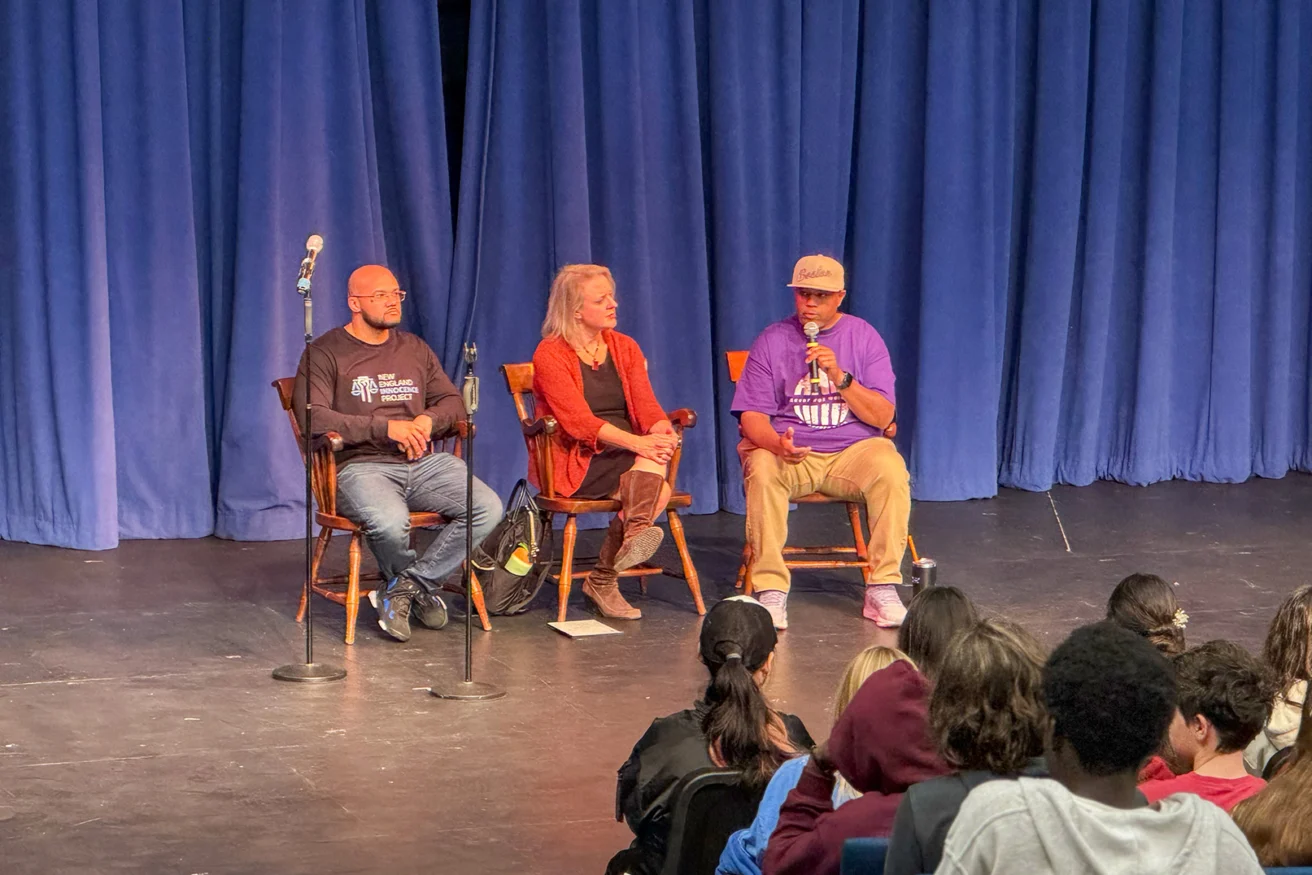
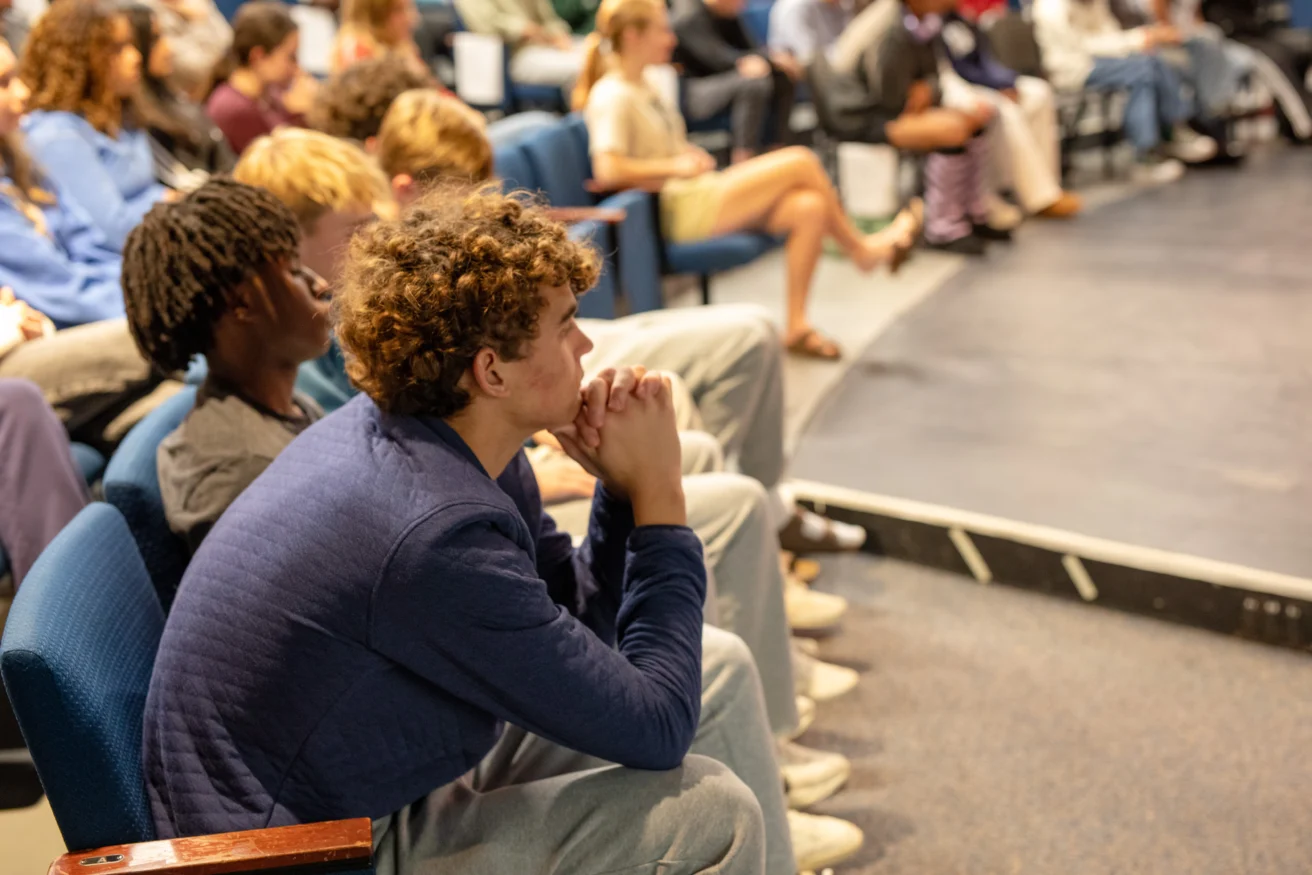
On October 15, 2025, Concord Academy’s student-led Prison Justice Project hosted an all-school assembly to raise awareness of wrongful convictions and the challenges exonerees face reintegrating into society. Club co-heads Jacob Himelfarb ’26 and Juliana Katzenstein ’26 introduced the speakers: Lisa Kavanaugh P’22 ’25, who directs the CPCS Innocence Program for the Massachusetts Public Defenders Office, and Sean Graham and Steven Pina from the New England Innocence Project’s Exoneree Network, both of whom were wrongfully convicted of crimes they didn’t commit and now work to support and advocate for fellow exonerees as they heal and adjust to life in freedom after long-term incarceration.
It was Kavanaugh’s fifth visit to CA in conjunction with Wrongful Conviction Day, which is observed annually on October 2. She said she has spent the last 14 years “representing people long after a jury got it wrong, long after they were falsely accused and kidnapped and charged with a crime they didn’t commit, and working with them to unearth the story of what happened to lead them to that injustice.”
The previous two years, Pina had also spoken at CA about his continued fight for exoneration after 28 years of incarceration, as well as his community engagement work with the Exoneree Network. Pina had been living in Atlanta in 1993, awaiting a baby’s birth, when he learned he was wanted for murder in Massachusetts. He returned to cooperate with the investigation but was ultimately wrongfully convicted in 1996. It took sustained interest from Florence Graves, founding director of the Schuster Institute for Investigative Journalism at Brandeis University, and a team of student journalists to bring evidence of his innocence to the attention of Kavanaugh, who helped secure his release from prison in 2022.
Since his last visit to CA, Pina had been granted a new trial. On February 3, his sentence was finally vacated, “which means I sit here today, no longer a convicted murderer,” he said.
Pina shared that just the day before, he had attended court in support of a friend who had also been wrongfully imprisoned for 28 years. It was unusual, Pina said, to hear the prosecution assert before the parole hearing that it declined to further pursue the case. Even so, the judge expressed concern. “Yesterday, I sat there in the courtroom listening to this judge who sounded like he was not going to grant this motion, knowing what that felt like, because I was sitting there about three years ago—knowing what’s going through his mind,” Pina said. “Then finally hearing the judge say that he was going to grant his motion to stay and allow him to go home, I instantly got up and went out of the courtroom and just broke down in tears.”
Celebrating the moment the “weight of incarceration” lifts, Pina also acknowledged that the transition brings a “weight of a new society”: the difficulties of adapting after decades behind bars to a world that has been thoroughly reshaped by new technologies.
Graham, who was wrongfully convicted as a juvenile and spent 18 years in prison, serves as the Exoneree Network’s community reentry and program specialist. He teaches financial literacy and helps people find housing and get psychological care for the trauma of incarceration.
“Court support is so important to us in our community, because most individuals had to go through this process by themselves,” Graham said. “So when something was done wrong, no one said anything. They felt like nobody cared.” Now, when the Exoneree Network packs a courtroom with supporters, he added, they notice a difference in the way judges, prosecutors, and even the defense engage: “The bigger we can make our community, the more accountability we notice from everybody involved.”
Students had a chance to raise questions at the assembly. Asked how she remains hopeful, knowing wrongful conviction is part of a systemic problem of racialized miscarriage of justice, Kavanaugh said, “I’ve spent my whole career fighting one person at a time, and there are moments when that feels crushing because the stakes are so high.” But, she added, holding events such as this, where individual stories become part of a collective narrative, helps get attention for that bigger picture.
Kavanauh stressed the importance of fulfilling jury duty: “When you have informed, thoughtful people on juries, fewer people get wrongfully convicted. It does make a difference.” And she cited other ways individuals can get involved—whether as attorneys, journalists, or volunteers.
“I love my work, and I feel like every person who comes home is a new member of my family,” Kavanaugh said. “I’ve been lucky to learn from every person that I’ve freed. I think my life is richer and fuller with every new person I meet. As hard as that burden is, it’s also the greatest privilege I can imagine, and I don’t ever want to do anything else.”