
Author and Filmmaker Curtis Chin Advises CA Students to Think Creatively about Careers
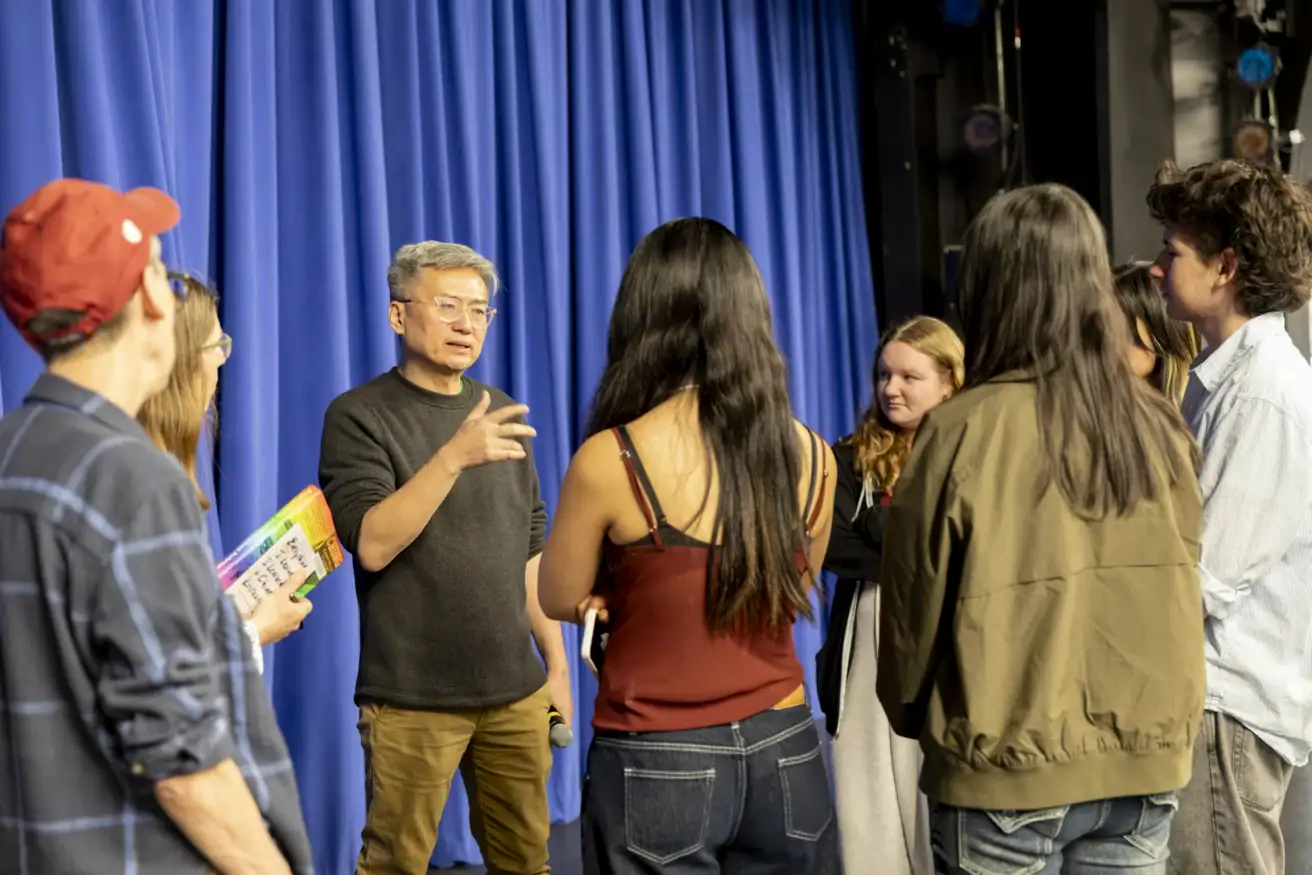
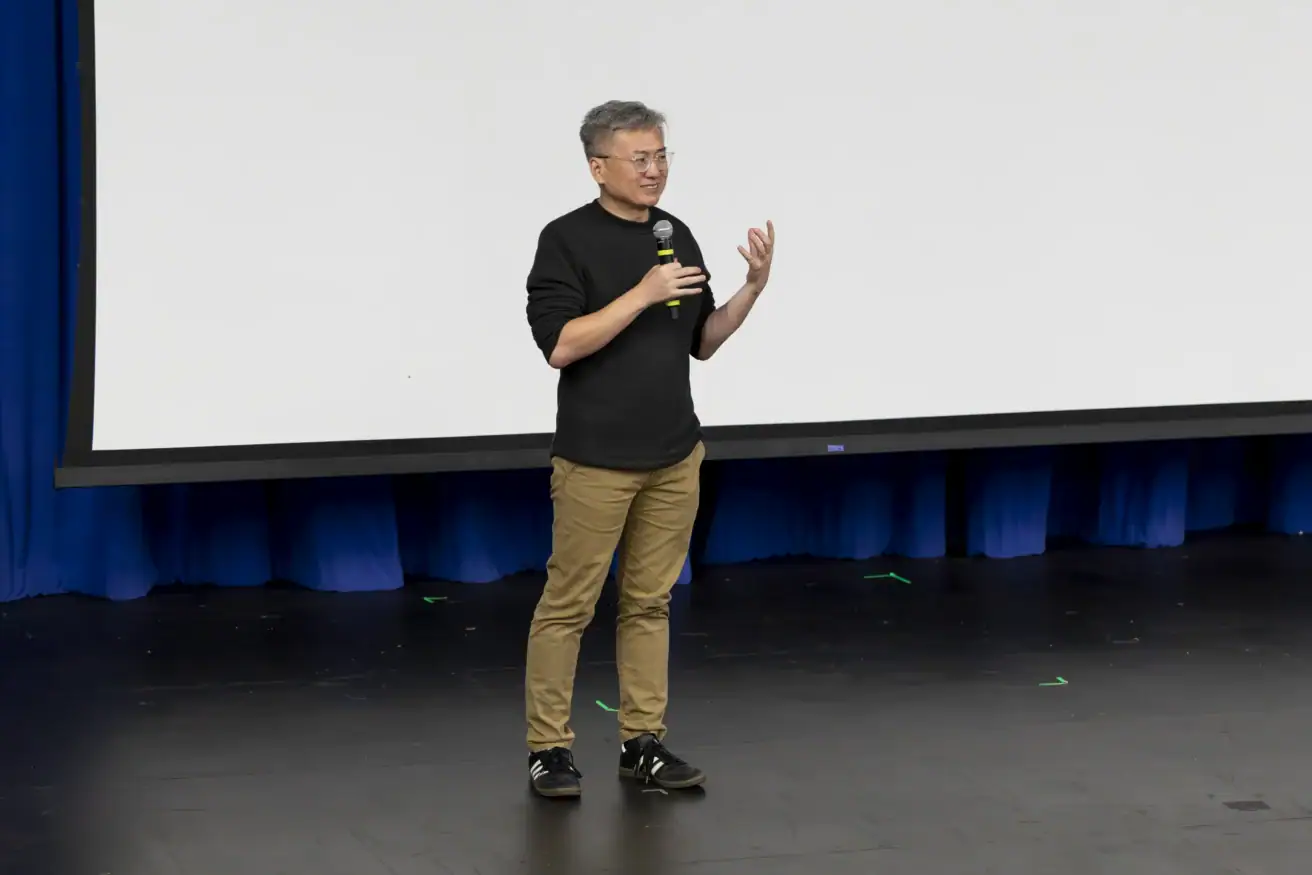
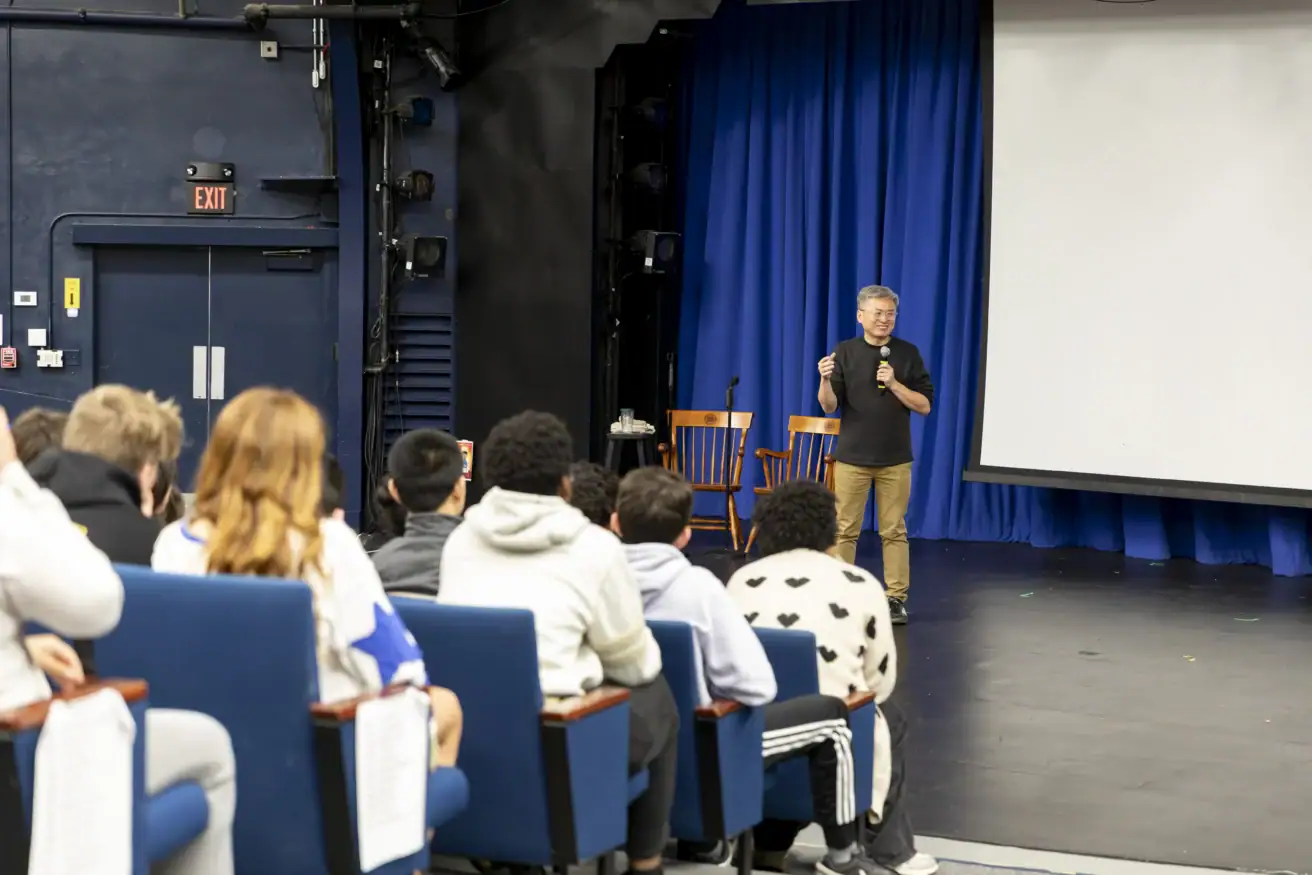
When LA-based filmmaker and author Curtis Chin visited Concord Academy on April 1, he invited CA students to engage with him in several ways. He sat in on a global literature class focused on home and identity, where he spoke about his 2023 memoir, Everything I Learned, I Learned in a Chinese Restaurant, about growing up Asian American in Detroit, coming out in his working-class immigrant community, and earning a degree in creative writing from the University of Michigan as a first-generation college student. Over lunch, Chin chatted with students about how his identities have provided grist for his creative work.
To begin his all-school assembly, he treated the campus community to an advance screening of his latest film. Warren King: King of Cardboard will premiere on American Masters on PBS on May 28. Chin’s documentary short follows an engineer-turned-artist who takes inspiration from the limitations of his medium, corrugated cardboard, to sculpt distinctive, geometrical life-size figures that reflect his Chinese American ancestry. The artwork is lovingly filmed, and Chin’s portrayal of King is intimate.
The screening provided an ideal entry point for a conversation between Chin and CA students. One asked him how he had captured such natural exposition from the artist and such a sense of closeness in filming him with his family.
“The first thing is getting people to trust you, because you know you’re asking people to open up their lives to you, right?” Chin said. “I think they just really have to feel that you have their best interests at heart.” On the other hand, he added, a director has to “keep enough distance so that you can ask those questions” that may make a subject uncomfortable—just when a friend might pull back out of courtesy, the artist has a responsibility to probe a little deeper.
Chin also spoke about the behind-the-scenes work needed to bring films to completion. Usually, independent filmmakers have to invest significant time and effort raising money for production and securing distribution, he explained. This film had an unusual origin: PBS, having aired an earlier documentary of Chin’s, Dear Corky, about the late photographer Corky Lee, had offered to fund a second short film about another artist of his choice.
After the opportunity fell in his lap, Chin learned about King through a Facebook connection. He said he “instantly fell in love” with King’s artwork. And as he got to know the story of a fellow Midwesterner who had struggled to balance his responsibility to family with his own artistic ambitions, their similarities proved just as compelling. “A lot of the things that he had gone through in life were things that I had also experienced,” Chin said.
A co-founder of the Asian American Writers’ Workshop, Chin has written for CNN, Bon Appetit, the Detroit Free Press, and the Boston Globe, as well as for network and cable comedy shows. His social-justice-focused documentary films have been screened in more than 20 countries. To contextualize these highlights, Chin presented his career path with a well-tuned ear for good storytelling.
As a new college graduate, he had moved to New York “to become a poet,” he said. Within three years of his first job, passing out Broadway flyers in Times Square, he won the state’s largest poetry prize.
“Then I met a boy who was living in Los Angeles, and so I left New York to pursue him in LA,” he said. “I stopped writing poetry, because LA is not the place to write poetry, and instead I started writing screenplays, because that’s what you do in LA, right?” A few years later, he was awarded an ABC Disney Fellowship and began a several-year stretch as a writer for Disney shows.
Then he got a phone call that changed everything. His father had died in a car accident, and his mother was severely injured. Chin was torn between taking over the family business, the Chinese restaurant his great-grandfather had established in 1940, or returning to Hollywood. “I decided to split the difference,” he said. “I would go back to LA, but I wouldn’t work for the studios anymore. Instead, I would work on these more personal projects, which fed more into my own personal identity as an Asian American, as a gay person.”
Answering questions from students interested in pursuing careers in the arts, he advised them, foremost, to be “flexible” about how they earn money. He noted, for example, how different the television-writing industry is now from when he was a kid. Then, only four networks were producing 80 shows a year, with 25 episodes each. Now, near the height of streaming-service production, around 400 shows have been going into production annually, though most with only six to eight episodes. Whereas once a show needed 25 to 30 million viewers to get renewed, now it takes only four to five million.
A downside: Writers’ rooms have become smaller, and those jobs don’t last as long. An upside: It’s easier to get shows with more diverse perspectives on the air. “Your chances of getting that first big break are higher,” Chin said. “Your chances of at least getting your show made into a series are higher, but your chance of getting rich off of that show are lower.”
Chin encouraged CA students to understand and make the most of their personal strengths—and not to self-impose limitations. “In these creative fields, you hear the word ‘no’ all the time,” he said. “Just make sure that voice is not coming from yourself.”
He recalled contacting 90 agents to represent his memoir—and getting 90 rejections. He reviewed the responses that expressed some appreciation for his initial pitch, structured around funny stories about his grandparents and the Chinese mafia, and he analyzed what was currently being published. With a retooled proposal to focus more on his writing on race and coming out, he went back to those agents and soon had four offers for representation. One ultimately helped secure him a good publishing deal.
“I could have taken any of those 90 noes and just walked away from it, but I didn’t,” Chin said. He advised having “thick skin,” saying, “You’ve got to figure out whether it’s a permanent no or a maybe no, and then you learn from it.”
He described a similar approach to directing. Just as he’d never taken a memoir-writing course, Chin said he had never taken a filmmaking course, but he hadn’t allowed that to deter him. Instead, he considered himself fortunate to work with strong creative collaborators.
“The technical stuff, like the angles, the lighting, and all that stuff—you can hire someone to do all that,” he said. “But the ability to find the story that you want to tell, and knowing that this is a person that you can connect with, and then actually being on set with them and talking to them—that is just people skills.”
And those, he said, are important in any career.