
CA Community and Equity Leaders Testify to the Impact of Belonging at AISNE Conference
Hundreds of educators and school administrators from across New England gathered in Waltham, Mass., from October 21 through 22 for the 2025 Diversity, Equity, Inclusion, and Belonging Conference hosted by the Association of Independent Schools in New England (AISNE). With the theme “Gather with Purpose: Stories, Voices, and the Power of Belonging,” the two-day event encouraged schools to deepen their commitment to creating communities that uplift every student.
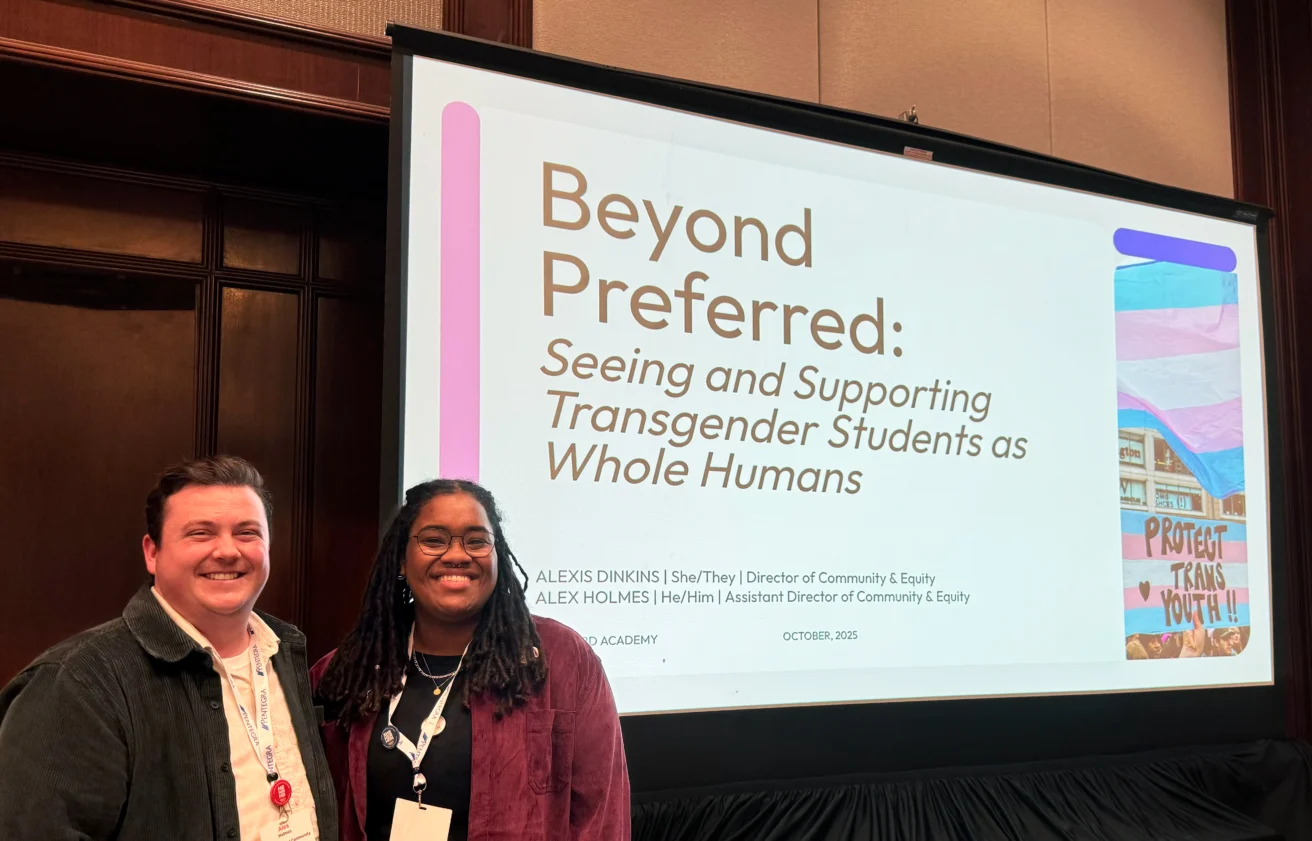
Among the many sessions offered was the workshop “Seeing and Supporting Transgender Students as Whole Humans,” led by Concord Academy’s Director of Community and Equity Alexis Dinkins and Assistant Director of Community and Equity Alex Holmes. Their presentation challenged educators to move beyond surface-level gestures toward more systemic, human-centered approaches to inclusion.
“Today, we are going to be talking about a paradigm shift—one that considers how we support trans students holistically, instead of just parts of their identity,” Holmes said to open the session.
Participants began with an exercise, reflecting on a student they had taught and felt connected to and listing as many of that student’s traits as they could recall. When they shared in small groups, many realized gender was not their focus— they remembered their students as multifaceted individuals.
“The thing that we want you to take from this training is that if you want to support your kids, you have to be able to support them as a whole student, not just as a person who comes in with certain pronoun pins on,” Dinkins shared.
The session provided a sobering look at the realities facing transgender and gender-diverse youth today. Data shared by the presenters highlighted that over 70% of transgender and gender diverse youth report significant anxiety. Amid increasing anti-transgender legislation and more limited access to gender-affirming care, the facilitators emphasized the protective potential of schools.
Policies that affirm gender diversity, inclusive curricula, affinity spaces, and ongoing staff training all contribute to a greater sense of belonging and improved mental health outcomes for transgender students and students who identify outside of a gender binary.
Holmes and Dinkins shared CA’s model for student support that encompasses student counseling, faculty training, administrative policy, and a culture of acceptance. They also discussed common barriers to effective student support, such as incomplete or inconsistent training, performative approaches to inclusion, avoidance of difficult topics, and limited input from students.
During an independent work period, educators reviewed a series of resources designed to help them assess their own practices. An institutional reflection encouraged them to identify their strengths and areas for growth. A myths and pitfalls handout prompted attendees to consider their confidence in addressing misconceptions, and a resource for further learning provided tools for implementing gender-inclusive practices. The work period concluded with a debrief, which allowed participants to share insights, questions, and actionable next steps for their schools.
The conference highlighted CA’s commitment to advancing equity and belonging in education. Through their expertise and empathy, Dinkins and Holmes inspired educators to build communities where affirmation and authenticity are lived every day. Their leadership modeled how intentional, systemic action can create schools where every student is empowered.