
Hall Fellow Rayner Ramirez ’88 Champions Deep Listening and Responsible Storytelling
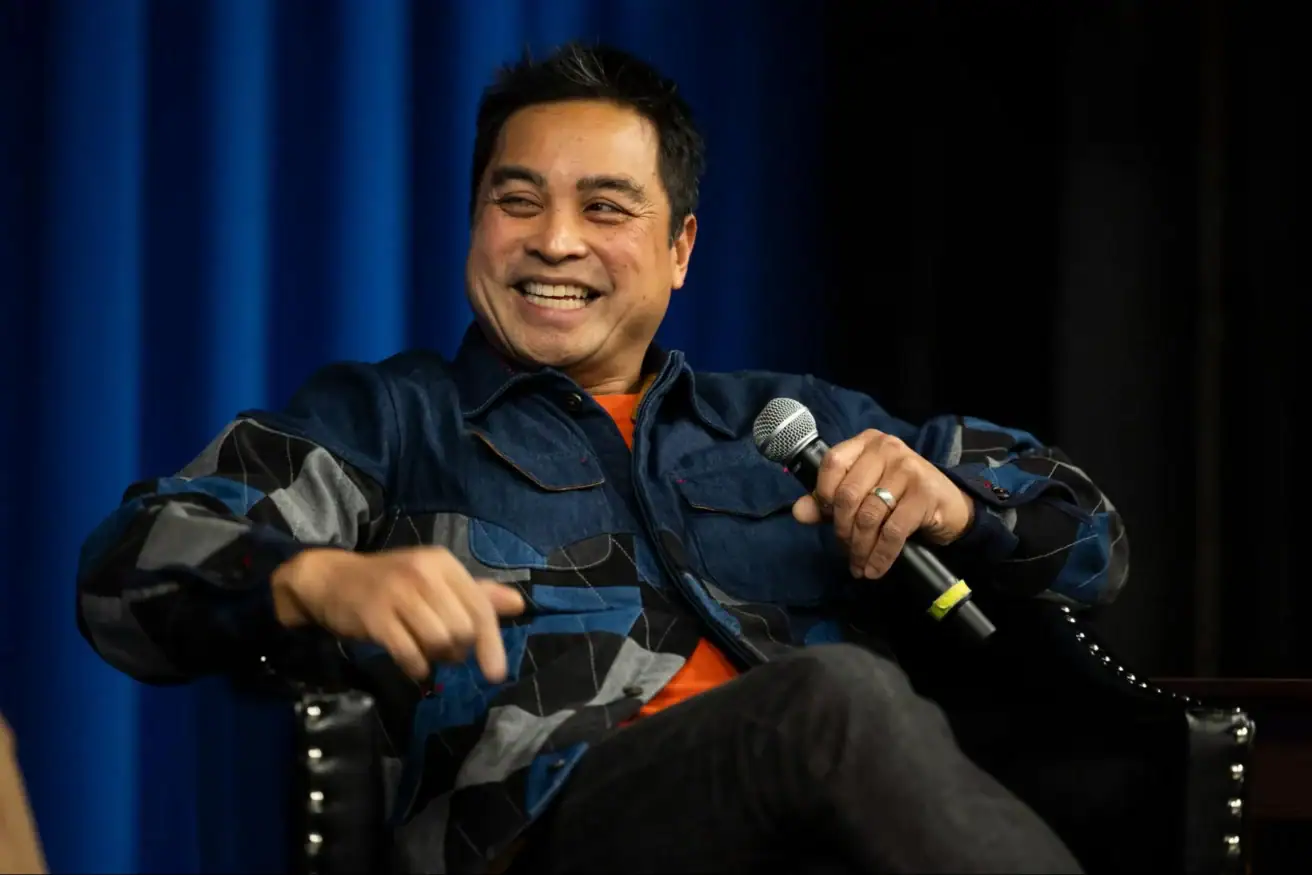
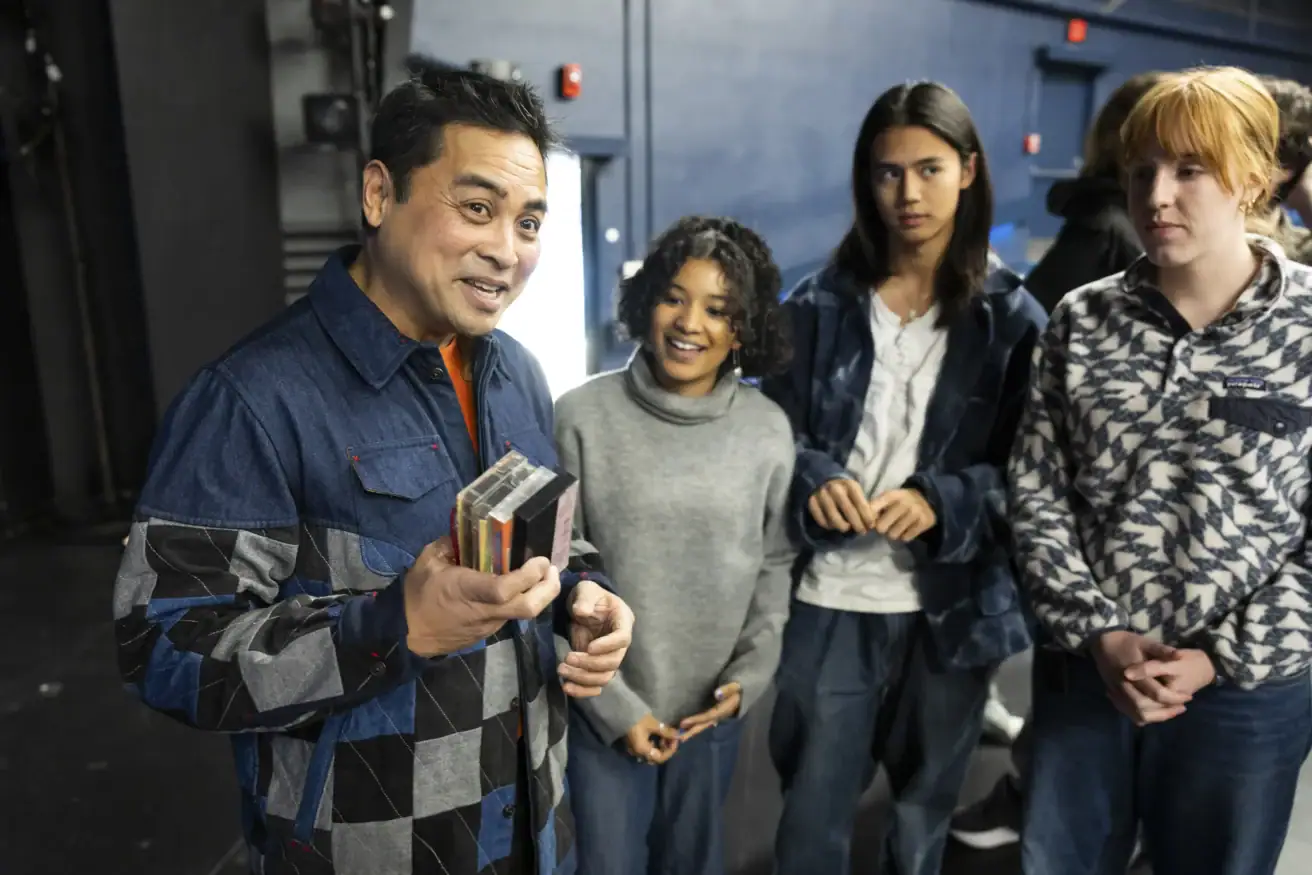
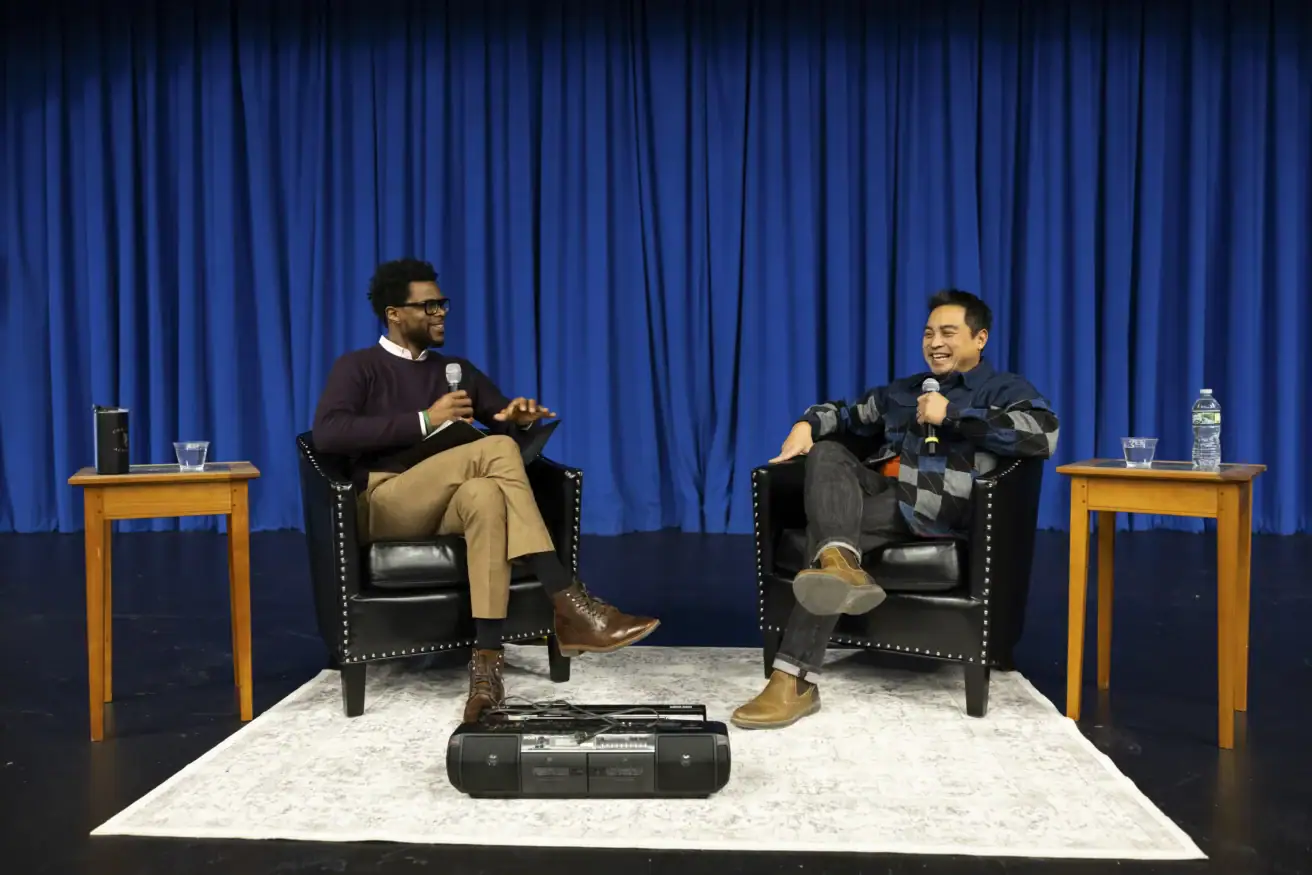
When 2025–26 Hall Fellow Rayner Ramirez ’88 visited Concord Academy on December 5, he came bearing gifts for CA’s library: a boom box, some of his old mixtapes, and a copy of Working, Studs Terkel’s 1974 oral history of regular Americans discussing their work, which Ramirez had encountered as a CA student. He said that reading it planted the seed for his documentary filmmaking career: “It was the first time I realized that ordinary people’s stories are amazing, and I wanted to be part of telling them.”
CA named Ramirez this year’s Hall Fellow to honor his thoughtful, purpose-driven storytelling about the human experience, focused on marginalized communities. An Emmy and duPont award-winning producer, he has combined investigative journalism and cinematic techniques to explore complex causes of conflict and uplift stories of compassion, resilience, and recovery. For two decades, he worked as a network news and documentary producer for Dateline NBC, NBC News, and CBS News, and he helped launch the cable channel Fusion, a joint venture between ABC News and Univision. In 2016, he and Amber Payne, his wife and business partner, co-founded the production company Tilt Shift Media. Its mission is to create documentary films with depth and integrity that can change perspectives.
Though others entrust him with their stories every day, when he spoke at CA, Ramirez said telling his own was “kind of uncomfortable.” Perhaps that’s why he began talking about his childhood by establishing historical context: The Immigration and Nationality Act of 1965 opened the U.S. for the first time to non-European immigrants—people from Asian, African, and Latin American countries—including his family, who came from the Philippines. His uncle emigrated first, then his mother, who worked in New York for two years before she could arrange for Ramirez and his sister to join her. At 10, having previously attended a strict Catholic school in Manila, he found New York City’s streets and his public school chaotic. In junior high, he began to get into some trouble.
“If it weren’t for this one teacher who believed in my potential, I wouldn’t be here,” he said. That teacher connected him with A Better Chance, a scholarship program that helps prepare and place students from underserved communities in independent schools.
“I was amazed and impressed by this place,” Ramirez said. Right away at CA, he got into the visual arts, photography, and filmmaking, which spurred his interest in visual storytelling. One of his first classes was an animation course; he made a film about a glove missing its match—its “one true glove.” Later, he made several narrative Super 8 films before trying his hand at documentary filmmaking his senior year.
One of his final projects for a film class was a documentary about the U.S. Immigration Reform and Control Act of 1986, which granted asylum to 3 million people. He interviewed migrants who had come to Boston to work and were pursuing citizenship. “It was a terrible, terrible production,” Ramirez said, “but it opened up my mind to being a teller of other people’s stories.”
He also said CA’s “culture of learning” expanded his sense of possibility. Designing an independent study to learn about the history of the Philippines, he said, “showed me that I could actually be the activator of my own learning and my own education.”
After graduating, during a gap year in New Mexico, he read an article in the New York Times about Pagsanjan, a village in the Philippines where Apocalypse Now had been filmed. He knew the place: His grandmother had grown up nearby.
“It was told in this sort of orientalist point of view, and that article just bothered me,” he said. “I thought I could tell the story from a different perspective.” He raised a small amount of money, including $300 from CA—enough to get him into preproduction and hire local crews to film in the Philippines for three days. A year later, he returned to CA to present the film.
After graduating from Eugene Lang College of Liberal Arts at the New School, Ramirez worked as a carpenter while making independent documentaries, before earning his graduate degree in journalism at Columbia University. He went straight into a job at NBC News. “I had this academic pedigree, a very pretentious film pedigree, and I was reading the New York Times and the Economist—I had not watched TV news in years,” he said. “My North Star in being at the networks was to make sure that underrepresented people’s stories were on the air.”
His first pitch was about the Filipino veterans who had fought alongside U.S. soldiers during World War II and had never received the benefits they’d been promised. “I had lined up everybody,” Ramirez said. “I was really excited. I was going to get the story on air, and they were like, ‘No, sorry. It’s not big enough.’”
Ramirez weathered many more disappointing responses from the networks, and he worried he had sold out, working for a corporate media conglomerate. “But it never stopped me,” he said. “I just kept pitching and pitching.”
He also made the most of opportunities that came his way. In his first assignment for Dateline NBC, over the course of a summer, he followed a family of migrant berry pickers (U.S. citizens) from their home in the Rio Grande Valley, in Texas, to Michigan. Recalling that their van regularly broke down along the way, Ramirez said, “The hardest part was being an observer, standing back and filming the whole time. It was really difficult for me to do, but it showed me the resiliency of the children.” He kept in touch with them; several years later, he did a follow-up story about the kids who had traveled and picked berries alongside their parents, after many of them had graduated from high school and college.

For 20 years, Ramirez produced stories about immigration, terrorism, health care, climate change, drug wars, human rights, and natural disasters. But he found the networks confining. “Broadcast news is very limited in terms of storytelling,” he said. “It’s often binary. There’s always good versus evil. You have to find the bad guys in the stories, and it’s not like that. It’s always much more complicated than that.” He took a leap to become an independent producer so that he could tell stories the way he wanted, “from a perspective of asset-framing, not deficit-framing,” he said.
The first documentary Tilt Shift Media produced was about the Harlem Children’s Zone, which interwove interviews with video shot by kids in Harlem in the 1980s and ’90s. “They had been sitting on this for decades because they wanted to tell their own story,” Ramirez said. “For years, Harlem had been depicted by the press very negatively, while people there were working to change and transform these communities. We wanted to tell stories about people of color.”
The project gave Ramirez a chance to look back at the New York he had grown up in during the ’80s, to tell its story from the perspective of communities coming together. “I beat the odds, right, coming from New York City, from an immigrant background,” he said. “Their concept was changing the odds for this community, rather than beating the odds for individuals.”
For Ramirez, it was a paradigm shift. “These stories of people making transformative change in their communities, it’s infectious, it’s inspiring,” he said. “You want to do it—you want to make a change. That opened up our whole world.”
He said that one of the great privileges of his work is listening to people: “There’s a lot of division—we’re all living in different silos—but I think we all want the same thing for ourselves, for our kids. We all want to feel good about doing something for our community, for others. Some people may disagree about what that action is, but you want to feel good about yourself. I think deep listening to understand is one of the hardest things we can do, especially these days, but we could use a lot more of it.”
Ramirez said responsible storytelling means not being arrogant when entering a community, being open to “even the craziest pitches,” and getting the facts right. “The journalism industry is under attack, and we need to be as factual and as truthful as possible,” he said. “Fact-checking is key right now to gain back trust in the process.”
He reflected on the rise of social media and the decline of trust in traditional news sources as disinformation, artificial intelligence, and algorithms have complicated how we stay informed. Ramirez said he’d like to see kids being taught media literacy at a younger age and journalism considered a skilled trade rather than a lofty endeavor. He also highlighted opportunities for young people “to use their phones in a positive way” to learn the skills of fact-based storytelling. “And you guys have a full-fledged studio here in the C.A.C. now,” he said. “It’s really impressive. You should use it.”
Noting the numerous writers and filmmakers in CA’s alum community, he advised students to tap into the Concord Academy network. “And read Working,” he added. “It’s just one of those great books that leaves a mark on you and sends you on a trajectory, even if you’re not sure where to start.”
The Concord Academy Board of Trustees established the Elizabeth B. Hall Fellowship in 1963 to honor the legacy of former headmistress Betty Hall. For more than 60 years, this endowed lectureship has brought distinguished individuals to speak on campus, many of them CA alums, including recent Hall Fellows Adam Geer ’99 and Caitlin FitzGerald ’02.