
Space and Support for Creative Collaboration

This community’s investments in our campus and endowment will benefit every CA student
When Fay Lampert Shutzer ’65 returned to Concord Academy in May to celebrate the completion of the Centennial Arts Center (C.A.C.), she was surprised by what moved her. A co-chair of the Centennial Campaign and former president of the Board of Trustees, she had helped plan the project since its inception. The view before her matched what she had seen in the architects’ sketches, seamlessly complementing the existing campus architecture. But she hadn’t anticipated its effect on her.
“The C.A.C. was positioned so beautifully it seemed that it had always been there,” Shutzer says. “It also made the Chapel seem larger and more important, because it wasn’t hidden—you don’t have to get up close to see it.”
Culminating decades of master planning, the construction of the C.A.C.—the largest capital investment in the school’s history— reshaped 40% of CA’s campus. The adjacent Academy Village faculty housing area, new open space, and a reconfigured Academy Garden were all created in coordination with it. And now the Elizabeth B. Hall Chapel stands at the heart of campus.
The C.A.C.’s completion concluded the successful Centennial Campaign. In addition to raising funds for the capital project, the community boosted CA’s endowment to over $100 million. This substantial investment has bolstered CA’s long-term financial stability, allowing the school to better support the faculty and students who contribute to the depth and diversity of a CA education.
Shutzer is a staunch advocate for CA’s endowment; financial aid has always been closest to her heart. In addition, she supported the C.A.C., naming the music recital hall in memory of her mother. A school can’t attract and retain students and faculty without appropriate spaces for growth and learning, Shutzer says: “We have something wonderful at CA, and we need to take care of it. Whether it’s a building or an endowment for financial aid, the goals aren’t so different. They really are toward the same end.”
Campaign co-chair Andy Ory P’16 ’21 and his wife, Linda Hammett Ory P’16 ’21, also supported both the C.A.C. and the endowment. “When our kids first set foot on campus, they benefited from almost 100 years of hard work, support, and stewardship,” he says. “We felt strongly that we wanted to be a link in this chain, to pay it forward.”
The new Hammett Ory Theater, which offers staging flexibility and technical theater learning opportunities, reflects their family’s love of the performing arts. It’s a space where students can explore the full potential of theater, dance, music, and design—and build community.
“The magic happens between the stage and the audience,” Ory says. “Especially as the world becomes digitally hyperconnected and can feel so lonely, showing up—being emotionally and intellectually present—is more important than ever.”
He says he’s thrilled when he looks back on what this community accomplished: “This campaign required so much from so many, for so long. What we’ve done together will have profound impacts.”

The C.A.C.’s soaring double-story hallway, filled with natural light, offers new ways for the CA community to connect.

Left to right: Fay Lampert Shutzer ’65, Andy Ory P’16 ’21, and Carol Moriarty P’02 ’05 ’07, campaign co-chairs, in the new Centennial Arts Center’s Kingman Support Shop.
On June 5, CA hosted a celebration in the C.A.C. for community members who had contributed to both the Centennial Campaign and the Annual Fund in 2024–25. Jennifer Pline P’13 ’15, co-president of the Board of Trustees, said that while the C.A.C. provides an inspiring new physical space for the community to thrive, “quietly, powerfully, the endowment supports our people and sustains this community.”
Her co-president, Jen Burleigh ’85, reflected that though the campus changes over time, what endures is CA’s “culture, its community, and its truly special approach to giving young people the tools they need to pursue their passions, which is what this building is all about.”
“CA is a place where students learn who they are—and who they might become,” said Head of School Henry Fairfax. Together, he added, the new building and strengthened endowment create the “foundation and the fuel for us to plan boldly for the future.”
A few weeks earlier, Carol and John Moriarty P’02 ’05 ’07 surprised Don Kingman, CA’s director of campus planning, design, and construction, when they revealed that they had named the theater support shop for him in honor of his retirement. The Moriartys have helped spearhead the development of CA’s campus since 1998. Over the same period, “CA had the good fortune of having Don Kingman be a wonderful steward of facilities and operations,” Carol says. “He also cared about every member of the CA community.”
Kingman says seeing the plaque—and a quote from his 2024 convocation address on the wall of the support shop—was a jolt, of the best kind. “When have you seen a beautiful space like this named for someone in a role like mine?” he asks. “To me, it says a lot—that the community I’ve cared so much about for so long also cares about each person’s contributions to the school.”
The Moriartys also honored Amy Spencer and Richard Colton P’13, former co-directors of the dance program, who instilled a love of movement, discipline, and creative expression in generations of CA students. The Spencer and Colton P3 (Process, Presentation, Production) Lab, dedicated to fostering interdisciplinary creativity at CA, is the Moriartys’ fitting tribute to Spencer and Colton’s legacy.
“We were aware early on that the arts were a huge part of the CA magic,” Carol says. “The existing P.A.C. was not adequate for the outstanding work that Amy and Richard were producing. We only wish it hadn’t taken this long for the C.A.C. to become a reality. We felt Amy, Richard, and Don should be recognized and thanked for their incredible contributions to CA, and we appreciate everything the advancement team did to make these recognitions happen.”
Colton says he and Spencer “had not imagined such a beautiful thing” as their names gracing the P3 Lab. He remembers when they began teaching at CA in 1989 in a low-ceilinged room that limited dancers’ leaps, and how the addition of the dance studio 10 years later opened possibilities and raised the program’s profile. He and Spencer worked with students to produce operas and other multimedia works alongside painters, singers, and instrumentalists, but finding appropriate spaces for such projects was always challenging.
“The P3—the whole building—represents a merging of the arts,” Colton says. “It couldn’t be more exciting to have film, theater design, and visual artists able to work in these spaces with dancers, actors, and writers.”
Interdisciplinary work isn’t easy, Colton adds, but that’s precisely why it’s valuable. It offers a productive template for a society that has become atomized through specialization.
Spencer says the arts are unique in cultivating multiple intelligences at once—linguistic, spatial, musical, bodily-kinesthetic, interpersonal, intrapersonal, and more. She highlights the holistic focus of the Moriartys’ long-term leadership in reshaping CA’s campus for the future. “From the beginning, they have understood why balance is so important—they know that’s a critical aspect of what makes CA different from other schools,” she says. “They have been tireless in their commitment to help CA realize its mission and its full potential— they put in the time, and they don’t give up.”
While head of CA’s Performing Arts Department, Spencer spearheaded a collaborative design process for the C.A.C. with performing and visual arts faculty and the architects. After retiring in 2021, she served as the Centennial Campaign arts liaison, supporting campaign co-chairs in their efforts. She recalls the benefits to the entire school when the Moriarty Athletic Campus opened in 2012 and CA Labs replaced an aging science wing in 2016. Now she envisions the C.A.C. attracting faculty, visiting artists, and students who are eager to experiment within and across disciplines.
“If you don’t have the tools at hand for exploration, the barriers for innovation are set,” she says. “The C.A.C. will give all CA students the means to realize their creative potential in many different forms.”

The C.A.C.’s music recital hall provides a beautiful setting for concerts, with acoustics that allow musicians to sound their best.

The Spencer and Colton P3 Lab supports cross-disciplinary creative collaboration, and it doubles as gallery space for visual artwork
A Historic Collective Achievement
Concord Academy’s new Centennial Arts Center is the most visible outcome of the Centennial Campaign, but the growing endowment also demonstrates a commitment to sustain the school, expand access to a CA education, and support its people and program. Both show that this community’s purposeful collaboration, creative engagement, and love of learning run deep.
More than 730 individuals and families collectively contributed over $53.3 million, surpassing CA’s goal and bringing the most ambitious campaign in the school’s history to a successful conclusion.
The community invested $26.8 million to redevelop West Campus and build the Centennial Arts Center, a creative hub that will enhance the education of every CA student.
With $17.6 million raised through this campaign, CA’s endowment has surpassed $100 million, allowing the school to continue to attract and retain exceptional faculty, provide financial aid, and maintain its commitment to educational excellence for generations to come.
And $8.9 million in unrestricted gifts demonstrated profound trust in CA to use the community’s resources where they are most needed.
Campaign Leadership
The success of this campaign reflects the contributions of a community deeply invested in the future of Concord Academy. It would not have been possible without the dedication of these visionary leaders.
Centennial Campaign Co-Chairs
Jane Du P’15 ’16 ’23
Andy Ory P’16 ’21
Carol Moriarty P’02 ’05 ’07
Fay Lampert Shutzer ’65
Centennial Campaign Steering Committee
Kate Agarwal P’23 ’28
Annie Bartlett P’24
Sam Bartlett P’24
Amy Cammann Cholnoky ’73
Jamie Wade Comstock ’82, P’17
Mike Firestone ’01
Alexis Goltra ’87, P’26 ’27
Kerry Hoffman P’14 ’20
Bradley Lewis P’24
Kristen Lewis P’24
Claudio Lilienfeld ’80
Kevin Parke P’12 ’15
Ashley Shih P’21 ’25
Linda Shih P’21 ’25
Jorge Solares-Parkhurst ’94
Carolyn Stafford Stein P’11 ’14 ’17
Ly Tran P’22 ’23
Nina Urban ’80, P’11 ’17
Peg Walker ’63

Catwalks above the Hammett Ory Theater give CA students full access to a technical theater education.

Dan Kramarsky ’79 at the June 5 campaign celebration.
Investing in Transformative Education
One of many CA community members who contributed to the Centennial Campaign, Dan Kramarsky ’79 shares why he supported the endowment. A career educator with 20 years of experience in independent schools as a teacher and administrator, his philanthropic goal is to support faculty development and financial aid.
Kramarsky says he was too immature for boarding school when he arrived at CA—a smart kid who “weaponized” his intelligence. “I thought I knew it all when I was 9, certainly when I was 14,” he says. “I did not know it all when, at 18, I left Concord.”
What made the difference? He says it was partly CA’s environment of common trust and “tremendously daring and wonderful” fellow students. At CA, Kramarsky learned to use humor effectively; he found space for expression as a theater kid, a joke-teller, and a singer. He also found teachers who modeled love of learning.
Among those transformative educators were Stephen Teichgraeber, Ronald Richardson, Janet Eisendrath, and Sylvia Mendenhall, all skilled at collapsing the intellectual hierarchy in a classroom. “These were teachers who were learning as they taught, who were forever students,” Kramarsky says. “The great ones consistently taught us that what they were teaching was the basics, and that we had a long way to go—and that they’d take that journey with us.”

The Centennial Arts Center’s eastern entrance to Academy Garden.

A view of the Centennial Arts Center’s rooftop solar array, with the site of the new meadow beyond the building.
Sustainably Built
It’s not just the electric vehicle charging stations out front that reflect CA’s commitment to sustainability. The materials and systems used in Centennial Arts Center have helped reduce the school’s environmental footprint even as its built environment has expanded.
Constructed to LEED Silver standards, the C.A.C. is insulated with 15-inch-thick walls and fully waterproof membranes. The all-electric building is 100% free of fossil fuels and draws from a 46-kilowatt rooftop solar array.
The building is also self-monitoring: Light, heat, and air conditioning levels automatically adjust to conserve energy when it’s not occupied. Night-sky friendly, it darkens from dusk to dawn. And a 3D-modeling program with powerful educational potential allows real-time insight into its operational systems.
The C.A.C.’s rear deck overlooks the boathouse and new meadow, dedicated by Amy Cammann Cholnoky ’73 and John Cholnoky in honor of Nancy Cammann P’73 and Dorothy Cholnoky, and pollinator meadow, dedicated by the class of 1969 in memory of Lucy Eddy Fox ’69 and in honor of their enduring bonds and shared love of the land. This haven for biodiversity will encourage scientific exploration and provide a serene spot for contemplation.
Space for Possibility
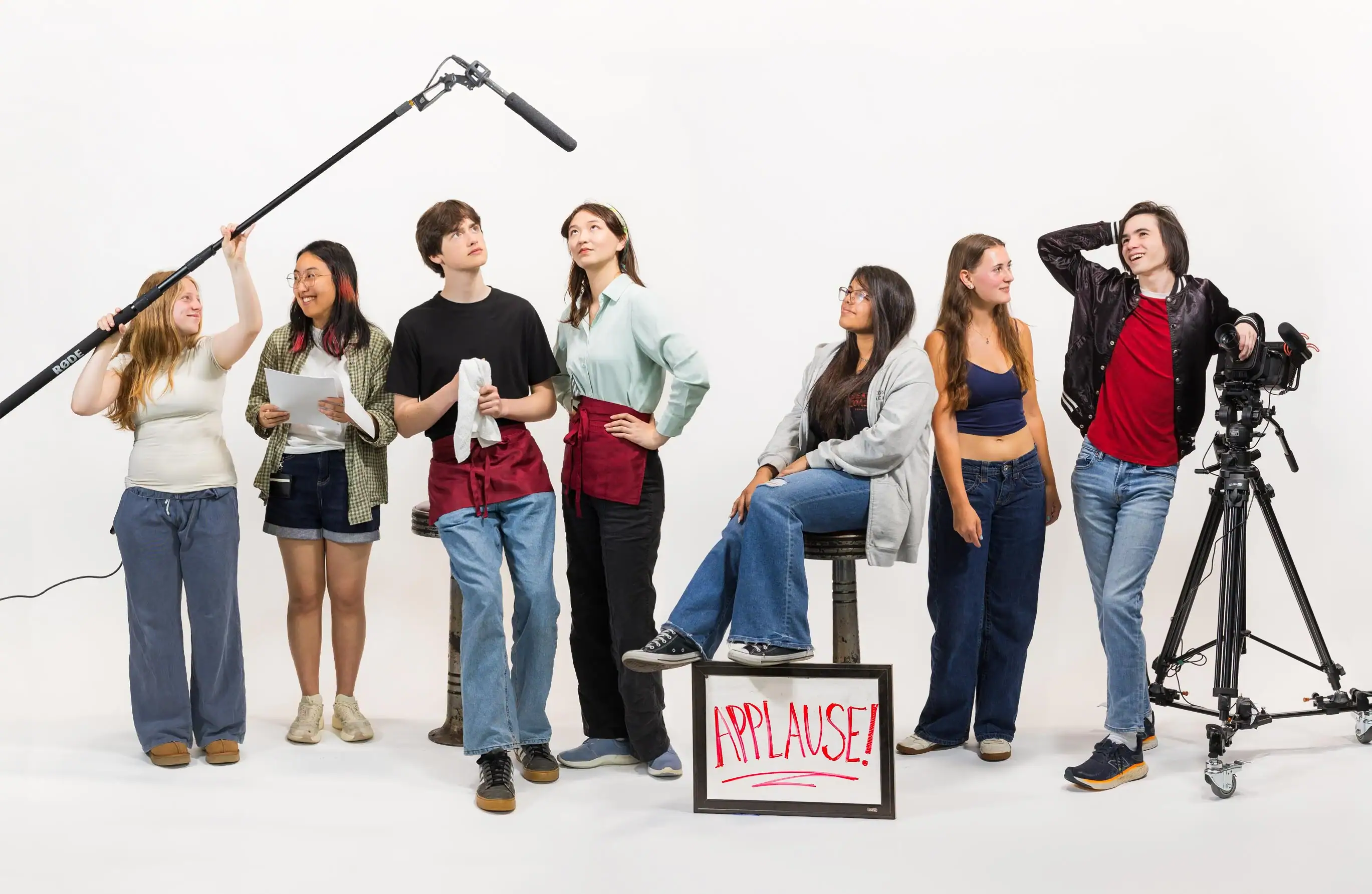
The Centennial Arts Center introduces high-tech, discipline-specific tools to CA’s curriculum, and many parts of the building have been designed for maximum flexibility. With recording capabilities throughout, rooms for collaboration, rehearsal, performance, and exhibition, and nooks for gathering, this building presents no foregone conclusions, just possibilities. Like a CA education, it inspires curiosity and exploration.
Carol and John Moriarty P’02 ’05 ’07 were honored to name the support shop and the P3 Lab, leaving a legacy for CA faculty and staff who, as they say, “shaped this place that means the world to us.”

The Kingman Support Shop, which connects with the P3 Lab, provides a loading dock, enclosed paint booth, and space for storing tools, lumber, and sets under construction. It stands ready to use to make anything, from architectural studies to art installations.

With a robust digital production lab for creating music, films, and podcasts adjoining a flexible space suitable for any set, the Spencer and Colton P3 (Process, Presentation, and Production) Lab will serve students at the intersections of performance, film, and the visual arts. Doubling as an exhibition space, it will provide critical interdisciplinary support for CA’s academic program.

In the Hammett Ory Theater, retractable seating allows for limitless staging configurations for mainstage productions, dance performances, and more. The Donohue Theater Control Room gives students learning technical theater the access they need. The theater’s flexibility also makes it a fine space for school dances, class meetings, and other community gatherings.

In the music recital hall, CA finally has a beautiful concert space, which Fay Lampert Shutzer ’65 and Bill Shutzer named in memory of Irma Lampert P’65 ’69. This acoustically optimized music hall overlooks the meadow, creating an ideal environment for performances and master classes. In the hallway outside, a monitor shows a livestream of concerts.

With acoustic panels and large windows overlooking student houses and Academy Garden, this room is designed for large ensemble rehearsals doubles as a classroom and event space.

Cozy nooks on the first and second floors welcome everyone in the campus community to gather with friends or curl up with a book.

The new Jasmine Music Practice Room, dedicated by a group of CA families, and practice rooms for percussion, jazz, and chamber music isolate sound and create ideal environments for rehearsal.

The C.A.C.’s lower level has dressing rooms, make-up stations, a shower, and plenty of space for creating and storing costumes and props.
Photos by Cole and Kiera Photography, Leah LaRiccia Photography, and Nicholas Pfosi