
A Commitment to Public Service, Born in the Classroom
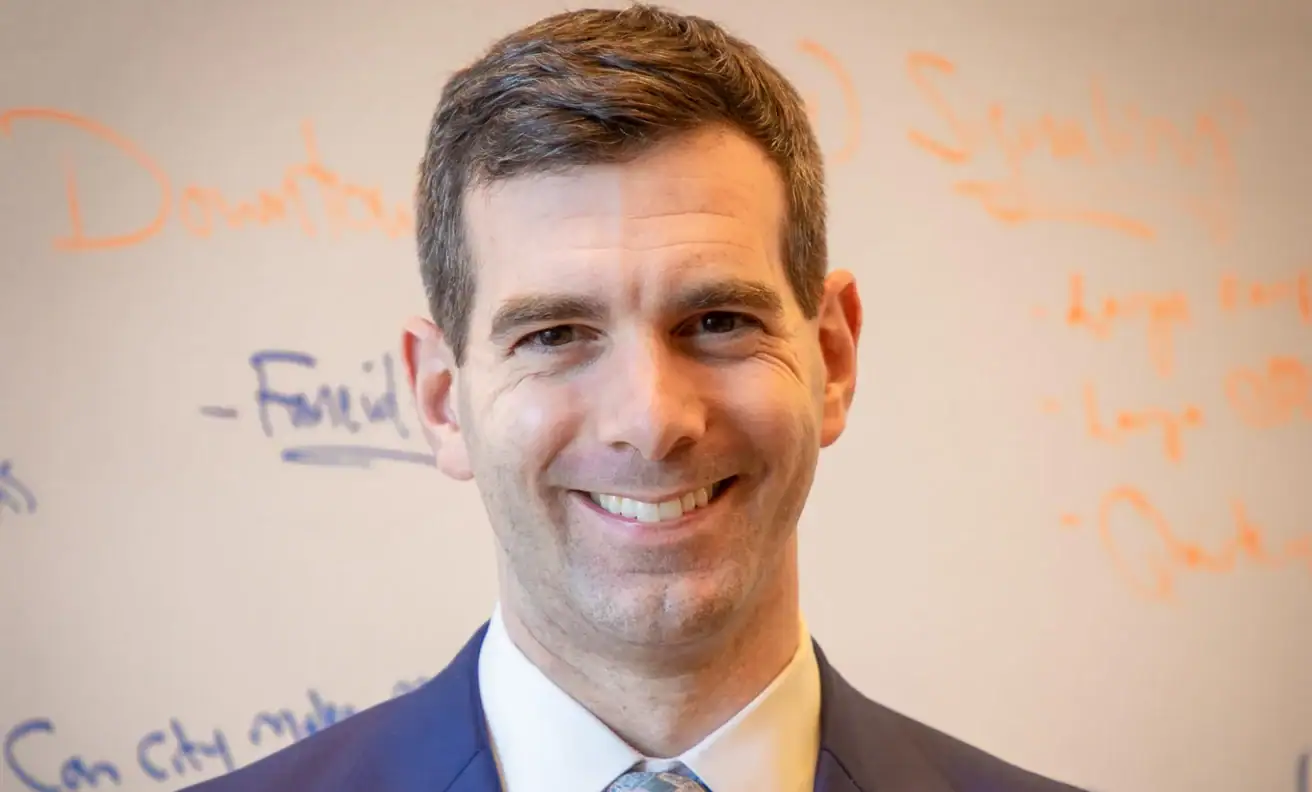
By Christopher Choy ’27
Inspired by a love of learning and a deep connection to community, Mike Firestone ’01 found an early path toward public service at Concord Academy. He currently serves as Boston’s corporation counsel, leading the city’s legal department. While a student at CA, he first became involved in politics and civic engagement. Firestone then attended Harvard University, where he earned a bachelor’s degree in history and a law degree from Harvard Law School.
As corporation counsel, Firestone leads the City of Boston Law Department to provide legal services to Mayor Michelle Wu, the city council, and city departments. In that role, he advocates for and defends the city in all legal situations, from everyday issues impacting the city to litigation that involves the United States Supreme Court.
His office handles legal issues including housing and land use, procurement and contracting, labor and employment, and regulatory compliance—while promoting accountability and fair delivery of city services. Firestone explains that the office deals with “core representational issues every day, whether it’s city maintenance or our obligations to provide an excellent education in the public schools.”
As a current junior at CA who commutes from Boston, I interviewed Firestone to learn more about his involvement with the city I am fortunate to call home. Throughout our conversation, we spoke about the CA experiences that led him to become involved with local government, the inspiration he draws from his current role in the City of Boston, and our interests in Boston broadly and in our shared neighborhood of Jamaica Plain.
At the heart of Firestone’s introduction to political organizing was the mentorship of a teacher who brought the community to the classroom. He credits former history teacher Bill Bailey, who taught a course on American politics and government. He says Bailey “wanted us to all get active in politics” and introduced him to the importance of participation in local and national elections.
Firestone remembers clearly when he and fellow CA students volunteered for the New Hampshire presidential primary in 2000, which he defines as “a really major moment for people of my generation.” That election revealed the importance of civic action, and he recalls learning how critical it was for him and fellow students to be involved in local campaigns: “That was my first experience as a high school student being involved in politics, and I’ve been active ever since.”
Firestone’s first official role in city hall was as an intern on the Boston City Council for a CA senior project, where he worked in a councilor’s office serving the Allston-Brighton neighborhood. His early career experiences included federal legislative work and leadership roles in labor and academic policy organizations. He then held key positions in the Massachusetts Attorney General’s Office, rising from assistant attorney general to chief of staff. He also managed major political campaigns and voter protection efforts at the national level, prior to serving in senior leadership for the City of Boston.
Firestone’s commitment to the city is longstanding and authentic. Living in Boston himself, he explains how valuable the city’s assets are to residents: “We have incredible cultural resources here, co-located in Boston because for generations in this community, individually and collectively, we have invested in building and sustaining institutions. Whether it is museums, universities, or hospitals, they have a tremendous impact on the economy of the entire region, and in fact, really shape the economic and cultural life of the entire Northeast.”
As local institutions face increasing federal funding and policy pressures, Firestone points to ways the City of Boston can support them. “Boston has a really critical role to play at this moment,” he says. “We need to stand shoulder to shoulder with [organizations] and recognize the collective value that we provide for the residents of Boston and for the entire region, and for the world, frankly.”
Firestone is proud of his commitment to the city. As a teen, however, envisioning making a political impact or becoming a catalyst for change can feel distant or intimidating. I asked Firestone how students should approach advocacy and politics, as this involvement can oftentimes seem confined to more experienced political leaders.
“At a time when politics globally and nationally can seem so fraught, divided, and far away, there is tremendous opportunity for engaged young people to see their passion and their work and their beliefs reflected in their local communities,” he says. “Whether that is supporting a candidate for local office or attending a community meeting about an issue affecting your own neighborhood, these are great ways to experience the reality of the political process and ones that are available to students in high school.”
The experience Firestone had with volunteering at CA is still available to students today. CA continues to provide opportunities that develop our passion for making change in our communities. From Concord Academy Students in Action (CASA) to the more recent Positivity and Light Society (PALS), CA supports students who strive to be, as Firestone describes, “connected to the world around them.”
For Firestone, public service is most meaningful when it remains closely connected to everyday life in the community. “One of the great things about working in local government in a city where you live and where you have kids in the schools is you have a real, immediate connection to the residents and to the work that you’re doing,” he says. “It’s such a fulfilling way to practice public service. I feel very lucky.”