
Can We Mend Our Civic Fabric?
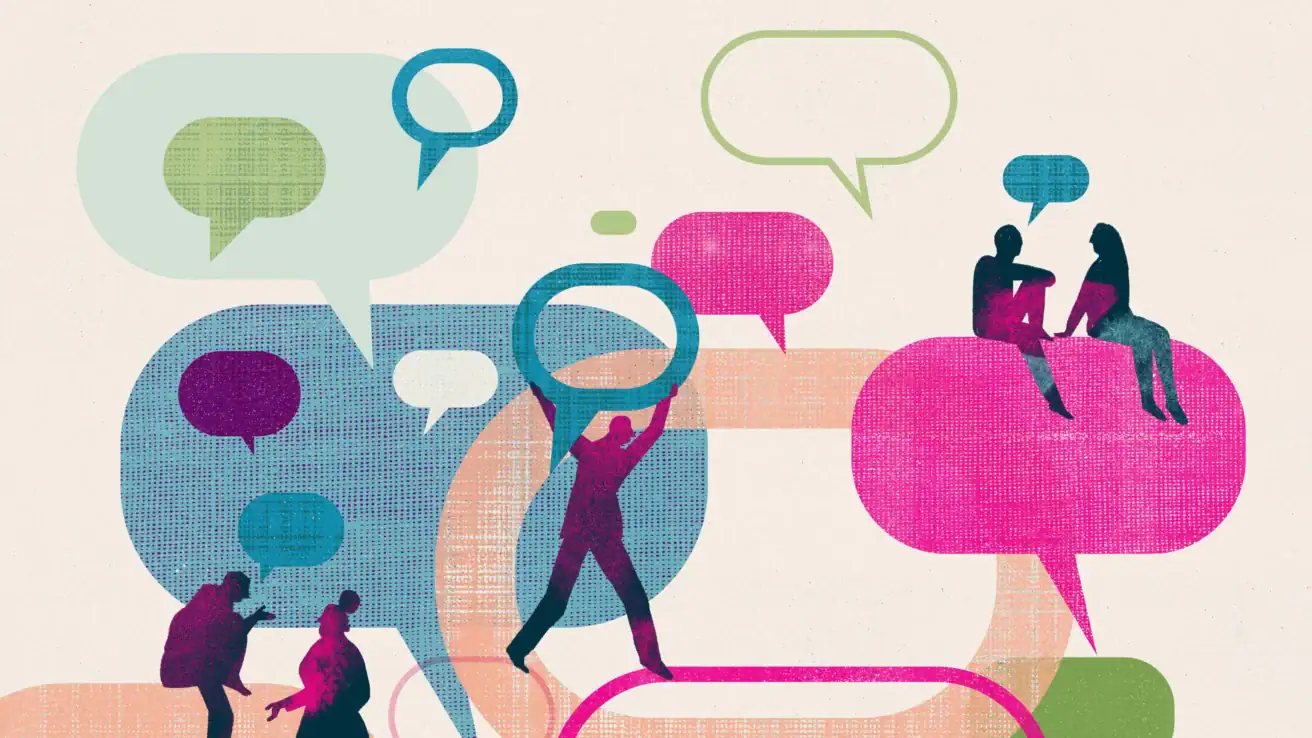
CA alums share their approaches to better communication
By Heidi Koelz
Community work has never been easy. Now, against the backdrop of a hyperpartisan public sphere, listening to learn and engaging in dialogue rather than debate seem like rare skills indeed. What can the people who practice them teach us?
We spoke with three CA alums who offer their distinct perspectives on communication, ones based on research, community-building leadership, and their own lived experiences. Their common thread is a commitment to creating more equitable and inclusive systems—and a focus on how we talk to one another to do so. Here’s what they’ve learned.
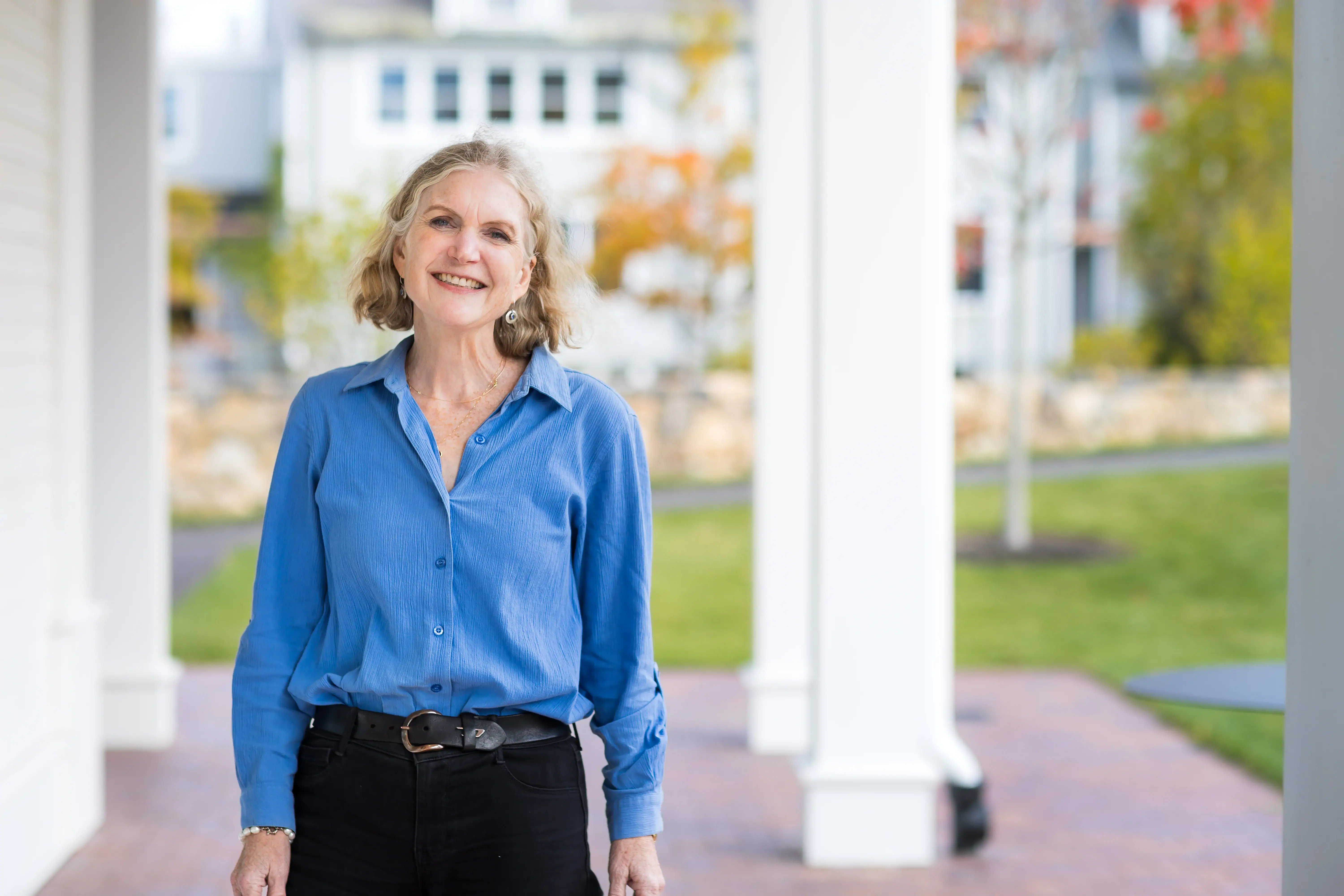
Katrina Pugh ’83
Kate Pugh ’83 has been studying dialogue for 30 years. She’s seen that facilitated discussions don’t often change people’s mental models, which reinforce assumptions and perpetuate othering. So as she was researching what kinds of speech deepen understanding and coordinate meaningful action, she wanted to develop a conversational framework people could internalize and self-facilitate.
“I don’t think you can have a mindset of ‘we’ if people haven’t stood back and said, totally neutrally, ‘Let’s look at what we just said,” says Pugh, a lecturer in the Information and Knowledge Strategy program at Columbia University. Even if people are willing to do that, she adds, they can benefit from a rubric that’s “practically defined and quantitatively justified.”
With a Columbia colleague, Nara Altmann, Pugh published a framework called “Conversation for Civility, Collaboration, and Creativity” in 2024. Based on Pugh’s doctoral research, this presents five “discussion disciplines,” or conversational features associated with rhetorical intent: courtesy (demonstrating goodwill and respect), inclusion (recognizing another participant or drawing them out), integrity (making informative or declarative statements), integrity-Q (inquiring or seeking clarification), and translation (summarizing or synthesizing what’s been said).
Using the framework, Pugh demonstrated that even a small shift in emphasis can dramatically influence conversational outcomes. In her doctoral research, she trained the first large language model, Google’s BERT (Bidirectional Encoder Representations from Transformers), to detect the five discussion disciplines and their impacts. Her research team had trained the model on data from public town halls about proposed aquaculture projects that had been hand-coded with the five discussion disciplines. Using the trained model, the team analyzed around 600 dialogues and evaluated the relationship between the shares of the discussion disciplines and the conversation outcomes.
“Sure enough, we found some really interesting relationships,” Pugh says. For example, when the share of inclusion increases by 10 percentage points, the likelihood of intent-to-act rises by 45%. Just as in “helping conversations,” greater acknowledgement and visibility make people more likely to take their roles seriously and commit to action. Similarly, with another dataset the team saw qualitative evidence that increasing proportions of questions and translation results in greater innovation.
These findings led Pugh to her mission to build a movement based on those five discussion disciplines. Even in in-person or online discussions dominated by indirection, disdain, or cynicism, they suggested, a group can move from transactional or defensive interactions to more curious, risk-taking, and forgiving dialogue.
In 2024, Pugh and Altmann co-founded the Conversation for Civility network, along with Columbia colleagues Eve Porter-Zuckerman and Steve Townsend. Its first meeting drew around 100 individuals committed to overcoming polarization through conversation. “People were genuinely ripe for attending to the features in conversation and how we can influence them,” Pugh says. Now she’s developing services and workshops for companies, nonprofits, and schools, as well as virtual trainings. Pugh says the framework is particularly applicable to organizations in transition; people in helping professions, such as teachers or hotline staffers; and nonhierarchical networks. But it’s broadly accessible too.
“The goal is that anybody could say, ‘We need more questions in this conversation,’ or ask, ‘Is anyone doing translation?’” she says. “These are systems-thinking skills that help us be more versatile. The disciplines create space for us to break habits of disparagement and dismissal and recognize each other as co-creators.”
Pugh grew up in Lincoln, Mass. At Concord Academy, she competed in cross-country and tennis, played flute in the chamber orchestra, and took part in a mainstage production. “CA was a really good, introspective place for me,” she says. “I could just be whatever I was.”
She majored in economics at Williams College, where she grew interested in understanding group interactions and wrote her senior thesis on the impact of unions on profitability measurement. Later, while earning a combined master of science degree and MBA at the MIT Sloan School of Management, Pugh was introduced to organizational learning and the lens of dialogue: “I said, ‘Oh, my goodness, this is the language I’m speaking.’”
To every professional role, she has brought her interest in dialogue—the nucleus of collaboration. Early on, she worked for major firms such as PwC, J.P. Morgan, Intel, and Fidelity before transitioning into knowledge management consulting. When the stock market crashed in 2008, she took time off to write a book, Sharing Hidden Know-How, about how to use conversation to elicit knowledge. Since 2011, she has taught the science of communities and networks at Columbia, where for six years she ran the master’s program in information and knowledge strategy.
During the pandemic, Pugh returned to graduate school, earning a Ph.D. in ecology and environmental sciences in 2022 from the University of Maine. She now consults with corporations and organizations on change management and artificial intelligence (AI) design for sustainability. Since its founding in 2023, Pugh has also been a partner in Weaving Futures, a collective designing impact networks to create conditions for human flourishing.
What does she make of our contentious public discourse these days? “We’re in a terrible mess,” Pugh says. “First, we have a political sphere that is all about division and accusation. Second, we have a social media sphere that is all about reinforcing perspectives we already hold or amplifying them to be more edgy or negative. And third, we have AI, which can encourage us to settle for partial solutions and pull us away from social interactions.”
She offers some advice: “Remember that our conversations really do have an impact—from those conversations with a 2-year-old to those conversations with your bus driver. You could be the best thing that happened to them today.”
Even in our fragmented digital environment, she adds, “Pay attention to the composite of your interactions. You may also find an opportunity to use a new conversation muscle. Because no interaction is too small, you can be the one to sow new forms of civility.”
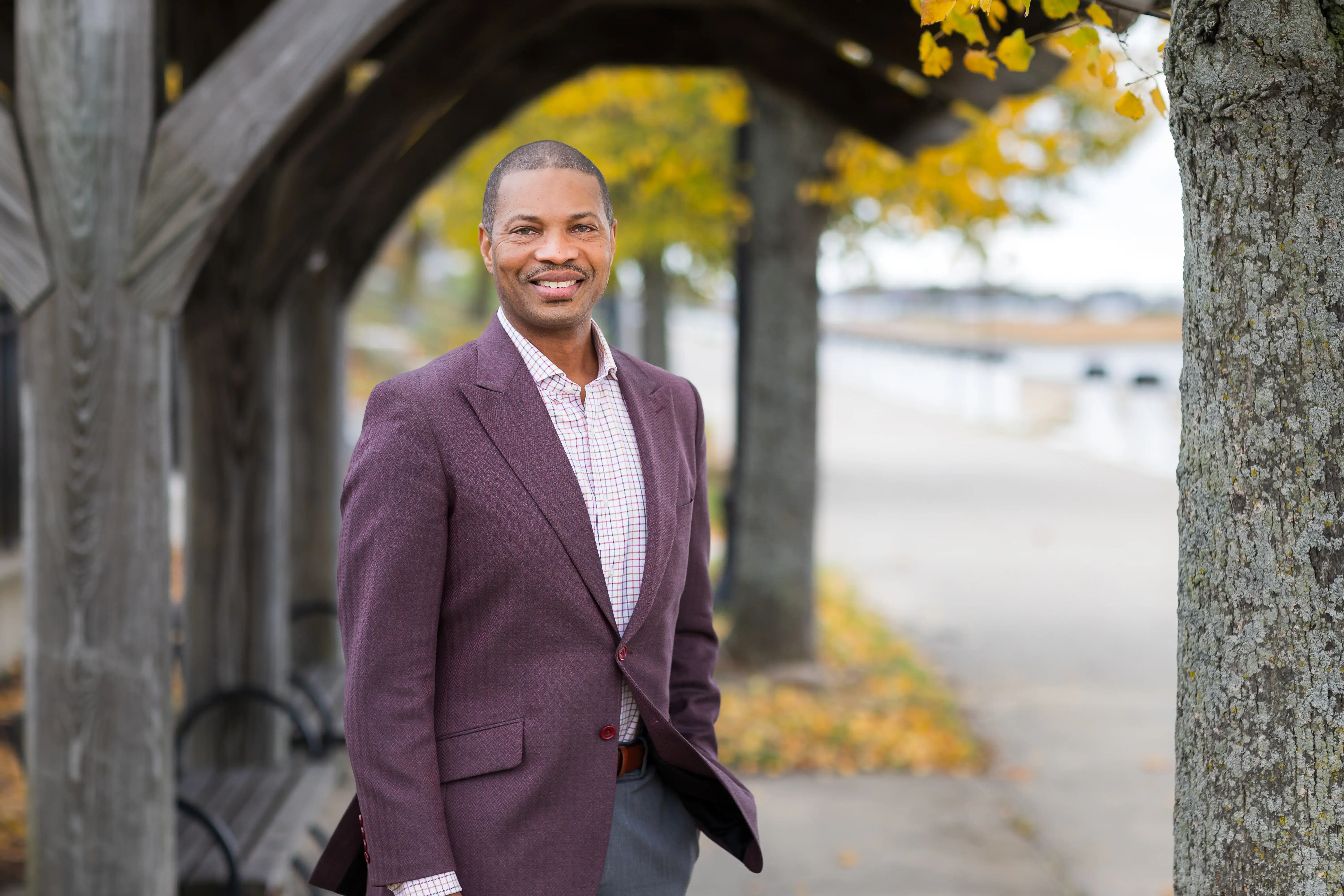
Turahn Dorsey ’89
Over his decades of leadership and coalition-building to bring about civic change, Rahn Dorsey ’89 has been motivated by curiosity. What new solutions can collaborative approaches to community development yield? How can we better communicate across differences?
As the president and chief executive officer of the Eastern Bank Foundation, Dorsey is driving its vision of building a thriving regional economy and more equitable and just communities in southern New England. With a mission focused on economic inclusion and mobility, the foundation works to improve early childhood education systems; integrate untapped talent in the workforce by lowering barriers to employment for immigrants, parents, and workers with disabilities; support small-business owners, particularly people of color and members of the LGBTQ+ community; and increase the supply of affordable housing.
“If all those things take a generation to do, what should we be doing that cuts that time in half?” Dorsey asks. “Where can we accelerate and achieve what some of my colleagues and I have started to call ‘escape velocity’? What can create enough propulsion to help households break free from the gravitational pull of the conditions that entrench poverty?”
Dorsey is particularly interested in ideas that accelerate economic mobility. But as much urgency as he feels, he acknowledges that conversation is as indispensable as financial, political, and institutional capital—and that it only moves at the speed of trust.
“I’m very thankful that I was born in the Midwest,” says Dorsey, a proud native Detroiter. “For Michiganders, it’s not foreign to have long-standing relationships with people you don’t agree with ideologically, so you’re used to negotiating on a more human basis.” He says the agency, identity, and sense of belonging he developed thanks to his native city’s Black Power ethic and blue-collar culture have helped him negotiate boundaries of racial and class identity throughout his life.
As a teen, Dorsey came to CA through A Better Chance and Midwest Talent Search, organizations that place high-performing students of color in independent schools. He says growing up in Black-majority Detroit gave him a unique perspective. “I actually didn’t have deep experience with the effects of political and economic segregation, because Detroit was, and is, an innovative place,” he says. “I came to Concord with agency, so it didn’t overwhelm me. I loved being able to reach out across difference, and I loved the challenge. I loved the opportunity to go searching for who I wanted to be.”
At CA, he leaned into music, formed lifelong friendships, and got a crash course in time management. “I was notorious for never sleeping and wore myself down every year, but it taught me a life lesson,” he says.
Long before he earned a bachelor’s degree in economics from the University of Michigan, an apprenticeship began shaping Dorsey’s career. At 16, he started working for a suburban Detroit firm owned by a family friend, who taught him to be a professional researcher and consultant. By 19, he was managing projects for the state of Michigan and the City of Detroit. In 1995, Dorsey moved to Boston to work at Abt Associates, a global strategy, consulting, and research firm founded by Clark Abt P’90 ’93, where for 13 years he conducted public policy research, covering 42 states and, he says, “learning a whole lot about community-based influence and what that has to do with systems change and public policy change.”
Dorsey went to work for the Barr Foundation in 2009 before joining the Boston mayoral campaign of his friend John Barros. When Barros entered the Marty Walsh administration in 2014, Dorsey did too. For four years, he served as Boston’s chief of education, leading, among other initiatives, the design of the city’s universal prekindergarten system.
After joining the Eastern Bank Foundation as a Foundation Fellow in 2019, he became its president this summer. He says he believes the foundation has a critical role to play in helping to spur “a broader conversation about the civic purpose of wealth and to negotiate for the social contract we need to promote economic justice.”
Dorsey doesn’t make light of the obstacles to building consensus in these polarized times. “There’s almost a rapid spiral to the basest version of society right now,” he says. “This is not a moment for sitting on the sidelines. This moment needs every institution to think about its purpose, its relevance, and what it wants to contribute to a different world.”
In New Hampshire, Dorsey is part of a 10-member, Black-owned farm called Movement Family Farm. In their first year growing garlic, they bought seed from an older white farmer who seemed suspicious of them until he realized they needed to learn from him. When Dorsey’s wife mentioned to the farmer that she’s a pastor, they bonded over an unexpected connection: The farmer’s mother had also been a clergy member, at a time when very few women were. “It’s fascinating,” Dorsey says. “His background confuses the whole picture, because now if you want to put him in a box based on his political views, you can’t.”
Dorsey says that encounters such as these—conversations with individuals with whom, on paper, he might not have a lot in common—give him hope for accelerating “heart-to-heart work.”
He often reflects on the process of navigating impasses and finding points of agreement: “You aren’t going to discover the commonalities without having the conversation, so you’ve got to make some level of commitment. I have the great fortune—and I actually think about it as a source of wealth—that these conversations happen pretty regularly in my life. Now I have a deep curiosity that drives me to pursue them more actively.”
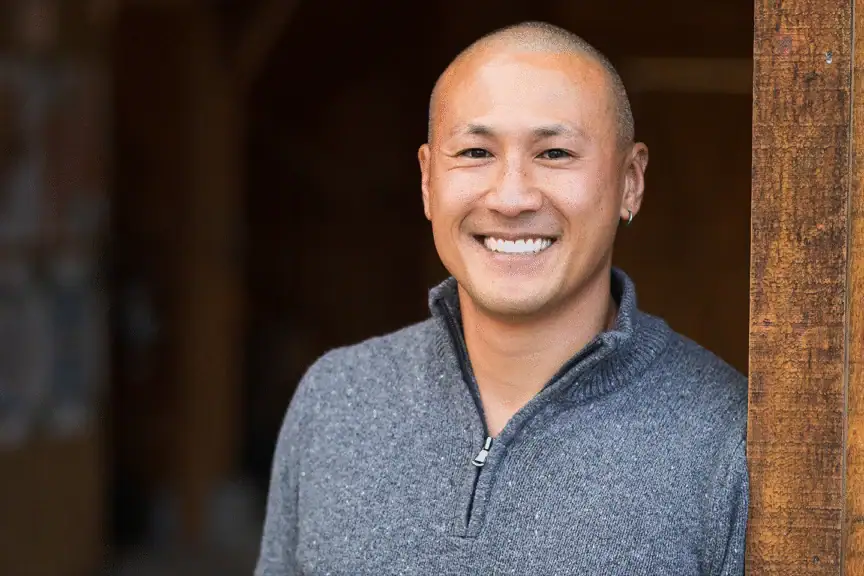
Eric Nguyen ’00
“It’s easy to affirm your values in the abstract, but hard to see that you’re not actually showing up the way you want to,” says Eric Nguyen ’00. As senior director of consulting and training at the nonprofit YW Boston, he works with corporations, organizations, and government agencies to help leaders and their teams understand their cultures and remove barriers to equity and belonging.
Nguyen and his colleagues conduct organizational assessments, make customized recommendations, and offer trainings on identity and bias, dialogue across differences, and giving and receiving feedback. They also model a highly participatory process of creating more inclusive decision-making structures. “The challenge is bringing together a diverse set of stakeholders, who each have their own needs and priorities, to clarify their values and define a shared vision,” he says. “We’re able to help people see things more clearly and communicate with each other in ways that are candid and honest, but also compassionate.”
Clients eager for solutions might request a two-hour workshop on microaggressions, for example. “We can’t really get to that until we do deep identity work,” Nguyen says. “The better we understand our own identities, which is where bias comes from, the better able we are to engage in dialogue, which—unlike debating—requires vulnerability, grace, and patience for hearing others’ perspectives. If we’re just thinking about being right, we’re only deepening divisions.”
He’s concerned that cancel culture has left little room for repair and restoration. “When people are operating out of fear, not wanting to say the wrong thing, you never get to what you need to talk about,” he says. “If instead you value a growth mindset, if you say, ‘We’re a learning organization,’ then you can think about putting practices in place to support that kind of culture. Helping people develop new schemas for communication is super exciting—it’s radically reimagining what the workplace, educational settings, and our relationships can be.”
Born in Boston to parents who had emigrated from Vietnam, Nguyen grew up in Lowell, Mass., and he watched his parents struggle to assimilate into American culture. He spoke Vietnamese fluently until he was 6, when they began encouraging him to speak only English at home and at school. “It came from their own experience of discrimination, of having their intelligence questioned because of their accents,” he says. “They didn’t want that for me or for my brothers.”
He regrets losing his first language and that deep connection to his cultural heritage, and he says it took a long time to unlearn the sense of superiority that accompanied his fluency in English.
When Nguyen transitioned from a racially diverse, working-class public school to CA, he experienced culture shock. He did well academically and athletically, but socially, he was on the fringes. Though he says CA was “ahead of its time” in having affinity groups, none existed for children of immigrants; being steered toward a group for Asian international students shaped his convictions about asking, not assuming, what community members need.
Still, with his advisor, Howie Bloom P’08 ’09 ’14, he found a second family. “Being seen, having adults I could go to, was powerful at such a vulnerable, pivotal time of life,” he says. “That relational piece of CA is something I bring along, and even those moments where I felt like I didn’t belong have been really helpful for me.”
One Martin Luther King Jr. Day, Nguyen recalls, students wrote down identities that were important to them and wore them on lanyards to start conversations. “That was a moment when I got to define for others who I was,” he says. “And I got to see how other people defined themselves in less visible ways.”
After earning a degree in psychology from Amherst College, Nguyen taught at several New England independent schools. Over time, he began enjoying helping colleagues implement more equitable teaching practices. While teaching and working in admissions at Noble and Greenough School, he helped start Achieve, a program focused on closing the educational opportunity gap for students in Boston’s public schools through summer enrichment and academic-year tutoring.
In 2018, Nguyen began managing a scholarship program at Northeastern University. He was struck by how many students from underrepresented groups faced structural barriers to belonging, which he worked to address. “With some of our most vulnerable students, if they couldn’t get housing, that was it—they couldn’t continue to be students,” he says. “It opened my eyes to the impact we can have if we operate at the systems level.”
After serving as the director for the Center for Inclusive Excellence at Framingham State University, he joined YW Boston in 2023. He recently worked with a nonprofit grappling with community tensions that hadn’t consciously considered its values in decades, and his assessment of a government agency uncovered rifts between leadership and staff regarding psychological safety, communication, and decision-making. To address such sensitive topics, Nguyen often uses a facilitated conversational framework, LARA (Listen, Affirm, Respond, and Add). “There are times it feels kind of forced, but it requires all the parties to agree to using shared language,” he says. “Why not remind ourselves that we want to listen to each other and affirm when we find moments of connection before we respond?”
But Nguyen stresses that there’s no single way to engage with others. In addition to social identities, he asks his workshop participants to explore various change-agent identities. “Some people are vocal about articulating needs,” he says. “But we also need people who can create coalitions and people who think about solutions. Too often, it’s the same person trying to wear all three hats, so you see a lot of burnout. That’s part of building community too—recognizing you have something to contribute and you don’t have to do it alone.”
Since 2022, he has served on the board of the Natick Organic Farm, in his community in Natick, Mass., where he helped staff establish a shared vision for inclusivity. The farm recently installed multilingual signs in English, Spanish, and Portuguese, hiring native speakers to translate the text. This fall, it purchased an all-terrain wheelchair for members of visiting school and corporate groups to use.
Nguyen says the conversations the board and staff had were as important as those visible changes: “We’re all stronger when we’re able to think more broadly about who our community is and how we can help people feel part of it.”