
ASL Symposium Adds a New Approach to Language Learning at CA
Many of the senior projects 12th graders complete during their final semester at Concord Academy have real-world applications, but rarely does one benefit other students so directly. In spring 2024, Jenny O’Malley ’24 developed a proposal for introducing an extracurricular language opportunity at CA. Their plan for a foundational American Sign Language (ASL) class became a reality this fall, when the support of a generous alum allowed the school to offer the eight-week symposium. The course drew so much interest that two sections ran simultaneously.
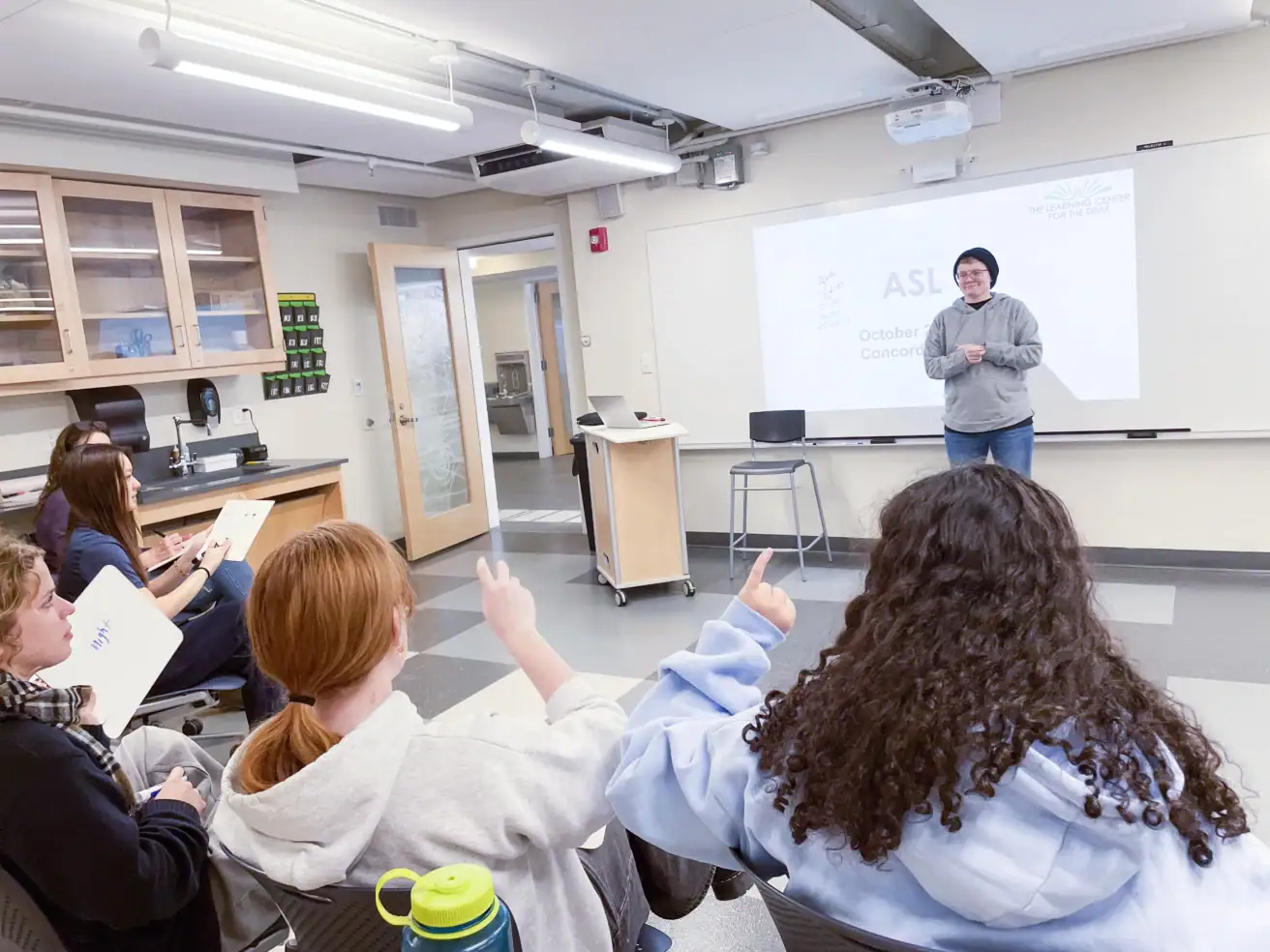
Taught by visiting instructors from The Learning Center for the Deaf in Framingham, Mass., the course enrolled 35 students, as well as two members of CA’s faculty and staff, who served as coordinators while also participating as learners. Meeting on Monday evenings in CA Labs, both sections prioritized fun and interaction.
Each week, the class began with finger spelling review, then practice signing words, numbers, and basic phrases, which contextualized the vocabulary they were learning. Within a lesson, students might progress from learning signs related to time (morning, Saturday, January) and family relationships (daughter, father, aunt) to reviewing numerical signs and, finally, putting them together into sentences (On Sunday, dad turns 50.) Students used whiteboards to ask questions and write responses to vocabulary quizzes, and they got plenty of practice signing throughout each class.
Joy Xu ’26 says the course was a “bonding experience” that helped her form new friendships with classmates, and she especially enjoyed the few times both sections combined. “Everyone was learning and struggling together,” she says. “While we were figuring things out, we’d laugh a lot, because sometimes we would sign something wrong and it would be really funny.”
When that happened, one of the instructors might shake her head with a comically pained expression, then write on the whiteboard: “You just signed hamburger.” The lighthearted approach made it appealing for students to keep engaging.
Joy says the symposium format also freed her from the pressure to get good grades, allowing her to enjoy the experience for its own sake. “I looked forward to it every week,” she says.
While the course was short and necessarily limited, she adds, she learned important skills for communicating using ASL: “I know how to spell my name, and I know the alphabet and basic signs. I know how to say ‘I’m confused’ or ‘I’m stressed’—I can express myself signing my daily emotions.”
Joy adds that she loves studying languages, but the physicality of ASL helped her learn in a different way. “You’re doing it with your hands, and doing it with your body actually helps you remember,” she says.
Another student, Emmy Summers ’28 agrees that learning ASL is different from other languages. “It’s intimate, because you’re not using spoken words—you’re much more vulnerable. It’s like learning another language, but you have to use much more emotion when you speak.” For that reason, she says she finds the symposium an ideal format.
Emmy had previously known a bit of ASL, since she started learning to sign when she was young to communicate with a family member. Having not needed it in years, she had let her skills atrophy. But when she saw CA was offering the course, she jumped at the chance to reconnect with the language.
She says she most enjoyed the games they played, such as telephone: “We would start off with a super complex series of words and then, by the end, it would be like ‘sun,’ ‘drive,’ ‘car.’”
“The teachers did a fantastic job with the instruction and creating a fun, warm space,” says Monica Ripley, CA’s ceramics teacher and one of the adult course coordinators. She adds that she often noticed students practicing together outside of class and discussing the course with others.
Carmen Welton, head of the Modern and Classical Languages Department, says the ASL Symposium wasn’t intended to be as robust as language acquisition through formal classes but rather an opportunity for students to explore something they could be passionate about. Welton was O’Malley’s senior project advisor when they proposed the plan for this course. “Jenny’s idea, from the beginning, was to offer something outside of the academic structure,” Welton says. “When we decided last spring to try to do it, it was pretty easy to incorporate. Jenny had done all the work, and they did it well.”
O’Malley, now a sophomore at New York University, was excited to learn that their idea had come to fruition. Currently studying Latin, ancient Greek, and Arabic, they say their love of languages started in middle school and blossomed at CA, so the focus of their senior project was a natural choice. But just as much of a factor was their interest in institutional operations. “I was curious about how the school worked, how curricular decisions were made, and how students could get involved,” they say.
CA’s relational culture made it easy for O’Malley to approach administrators, who welcomed their questions. “I went into it pretty ignorant about what I wanted to do or how things work, but people were excited to help me and took time out of their days to show me their processes and give me suggestions,” they say. “It was cool, because it was a different type of guidance than I was used to, and I learned a lot.”
At first, O’Malley considered modeling an extracurricular language program on individual music instruction, thinking students could take private lessons with tutors for partial credit. But they would miss the benefits of speaking in groups.
Welton suggested a different existing structure: the Environmental Symposium. Its once-weekly evening format seemed promising to adapt, but it would limit the school to offering a single language outside of its regular curriculum. O’Malley wanted to propose something many students would take an interest in. Originally anticipating a language such as Russian or Arabic, they didn’t even consider ASL until a friend suggested adding it to the options in a student survey. It emerged as the most popular choice. So O’Malley began researching options for local instruction and contacted The Learning Center for the Deaf.
“I couldn’t imagine doing something like this at any other school,” O’Malley says. “I’m really glad I got the opportunity and that something came out of it. I’m glad so many people are interested in something I was able to create.”
Welton says she would like to see the ASL Symposium set a precedent—as a format for future ASL courses building on the basics, and potentially for other languages at CA.