
Activism Starts at Home
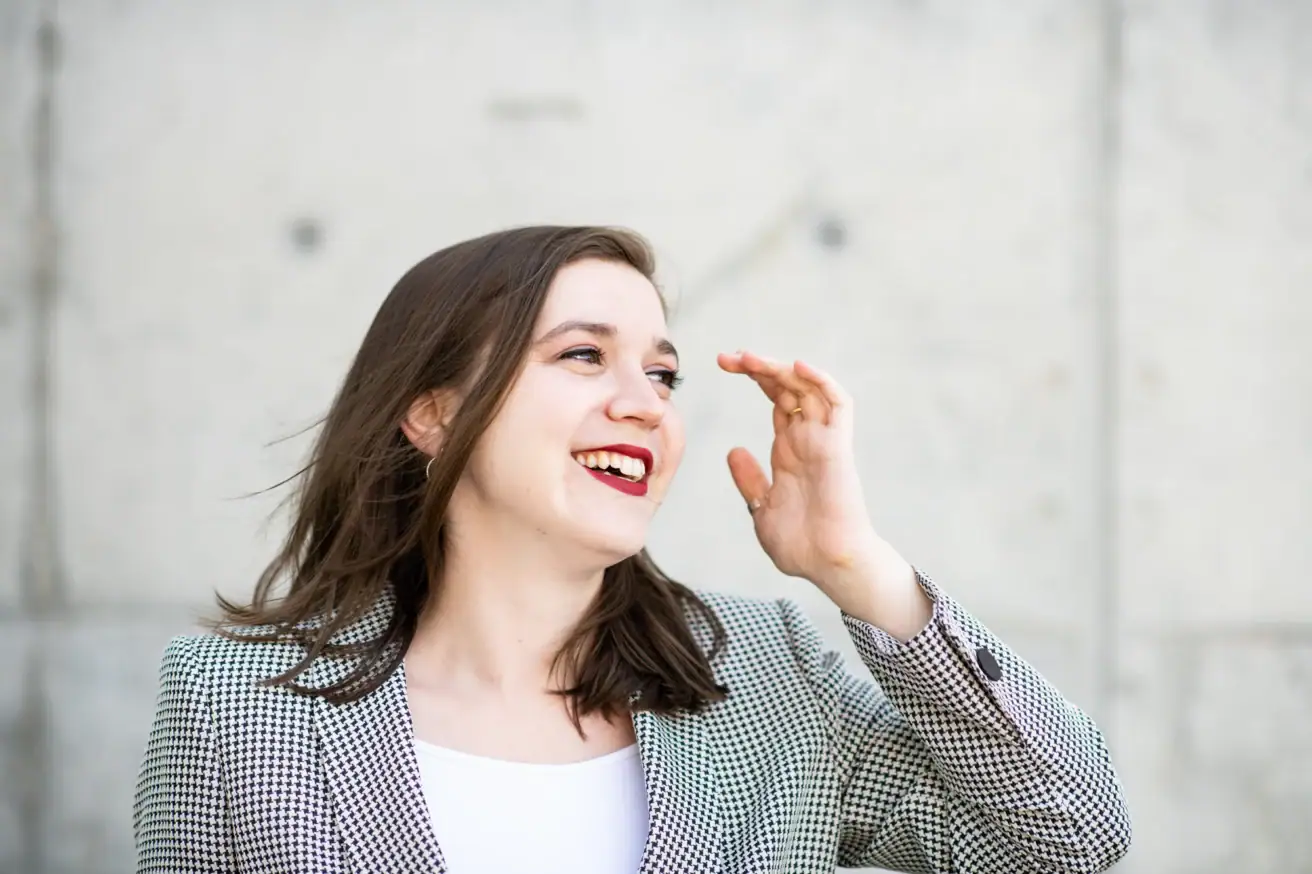
Corie Walsh ’12 shares insights from her peacebuilding career
By Nancy Shohet West ’84
For Corie Walsh ’12, social change has always meant rolling up her sleeves and getting to work. She organized protests to raise awareness of ethnic violence in Darfur as a 10-year-old, and in middle school she undertook her first hunger strike in solidarity with refugees facing food shortages. During her teenage years, she helped out at a transitional housing program each week. As a young adult, she moved to Uganda to establish community programs, then to Yemen to implement humanitarian programs.
With parents who were both community organizers, Walsh grew up amid activism in Cambridge, Mass., which is home to many Sudanese refugees. “All the way back in grade school, they were my friends and my fellow community members, not simply a distant cause that needed our help,” she says.
In 10th grade at CA, Walsh was co-head of Students Promoting Empathy, Action, and Knowledge (SPEAK) and a member of the Concord Academy Service Activists (CASA). As a junior, she took an influential class that explored models of social justice, taught by Elizabeth Bedell, and as a senior, she did an independent project on comparative genocide studies. In addition to her parents, Walsh credits her CA faculty advisor, Shep Shepard, with providing steady guidance and mentorship throughout those years.
At the University of North Carolina at Chapel Hill, Walsh majored in peace, war, and defense. “Attending a large state school where many people were very different from me shifted and expanded my worldview,” she says. Her senior thesis was on civilian behavior during the Rwandan genocide.
“Among the questions that consumed me was that of how mass atrocities and genocide can happen,” she says. “War itself can have many causes: economic, geographic, political. But how do you get to the point where you are trying to eliminate an entire population? I knew the best way to find out was to build relationships with communities who were going through this.”
After college, an internship in Washington, D.C., led to a salaried position with the nonprofit Mercy Corps, for which Walsh moved to Sana’a, the capital of Yemen, in 2019. Due to increasing conflict, it was at the time undergoing one of the worst humanitarian crises in the world. There, her work involved developing programmatic strategy and evaluating performance.
“One of our largest barriers in Yemen was that most of our donors and funders had not been in the country since the war began, and yet they were still setting our agenda,” Walsh says. “I knew that what we really needed to be doing was capturing the voices and expertise of the Yemenis themselves. People closest to the problem, in any humanitarian situation, should have a say in what the solution looks like.”
Ensuring that the right voices are part of the conversation has been a throughline of Walsh’s approach to peacebuilding work. She returned to the U.S. with Mercy Corps in 2020, and in 2021 she began working for Humanity United, a private philanthropic foundation that awards grants to organizations trying to find peaceful solutions to conflict. Now a senior portfolio manager there, she manages strategy and influencing efforts aimed at transforming philanthropy as well as budget and decision-making processes for the peacebuilding team. “The central concern that drives us is how to support the creation of a system that shifts power and agency to peacebuilders on the frontlines,” she says.
But with the closure of the U.S. Agency for International Development in January 2025, among other large-scale funding cuts, everything changed. “The rug got pulled out from under us,” Walsh says. “USAID shut down, and funding for peacebuilding and human rights work around the world stopped suddenly.”
Walsh is currently working for Humanity United remotely from Paris while her husband completes graduate studies there, and she says the world is facing ever-increasing challenges: “We just completed a survey that looked at the global impact on peacebuilding organizations of the recent funding cuts. We learned that 55% of local organizations will soon be completely out of funding.”
Despite the political upheaval of our times, Walsh is not without hope. “Much as we might wish otherwise, we find ourselves in a profound moment of transformation,” she says. “We are compelled to think differently about how funding, decision-making, peacebuilding, and human rights resources should be organized, and we have an opportunity to build a more just way of operating.”
Observing so many people coming together to support neighbors in need, whether by donating, volunteering, or protesting, “helps to counter the negative social structures afoot right now,” she says. “The issues I have worked on around the globe are not so different from the challenges we now face at home. We need to keep sight of the fact that social change doesn’t happen in the voting booth every four years. It happens every day in our communities, and it comes from all of us.”