

Ashley Yu ’26 Explores Cutting-Edge Algorithms Through MIT PRIMES Program
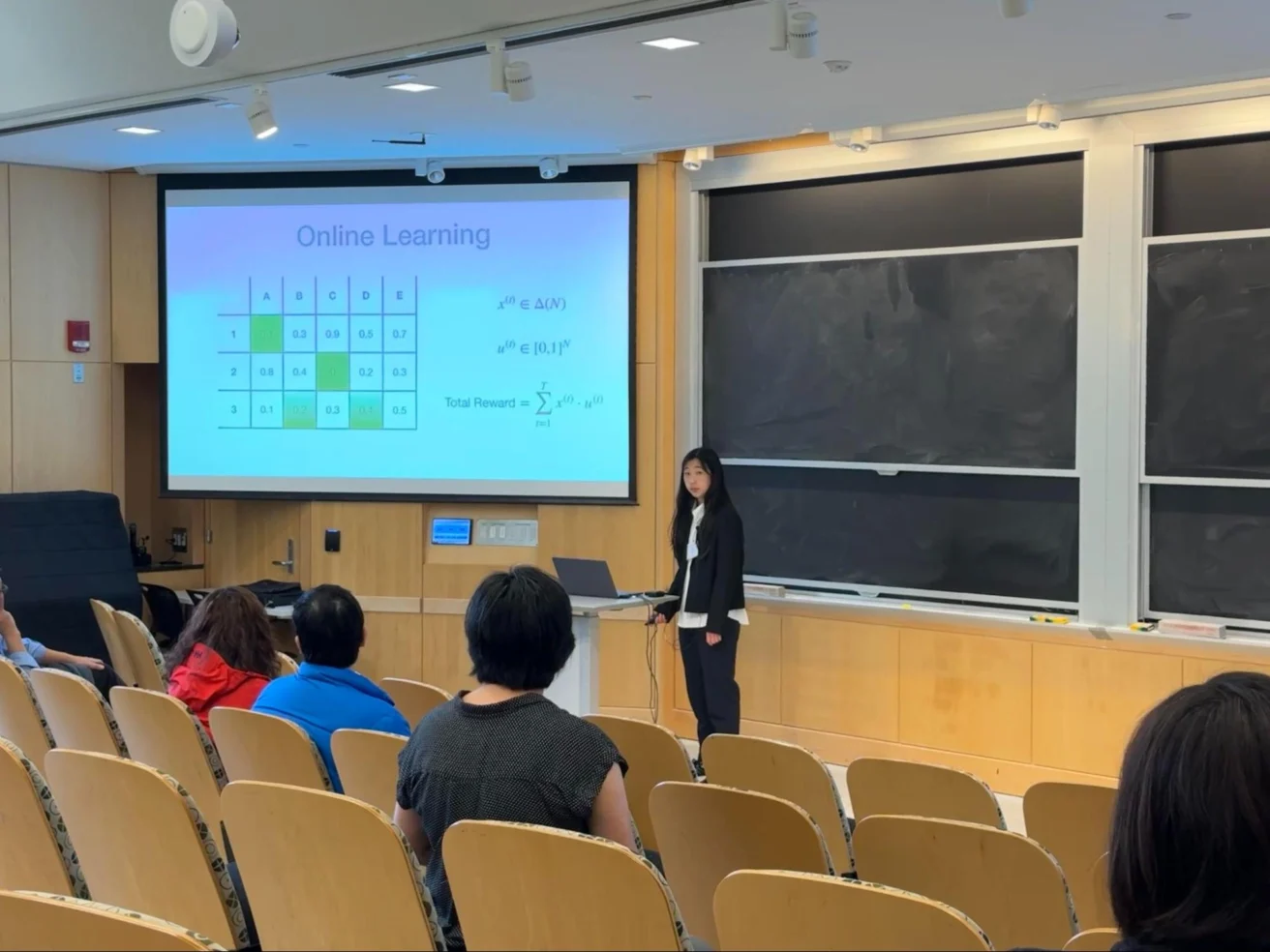
For senior Ashley Yu ’26, joining the MIT PRIMES program was more than just an academic opportunity—it was a chance to carry forward a tradition.
She was inspired to apply by Irene Jiang ’24, who had first heard about the program from Lisa Liu ’22. “It’s an honor to continue this legacy of CA women in STEM,” Ashley says.
PRIMES participants work with MIT researchers on exciting unsolved problems in mathematics. Ashley’s research focused on the mathematical concept of regret, a measure used to evaluate how well algorithms perform in game theory. Last year, she studied external regret, which compares an algorithm’s performance to the best fixed action.
This year, she studied swap regret, a more stringent measure that asks how much better one could have done in a repeated decision-making process—for example, a game of rock-paper-scissors—by choosing different actions each round.
Her project explored how to speed up algorithms that minimize swap regret. While traditional methods are mathematically precise, they often slow dramatically when dealing with many possible actions.
Ashley’s work aimed to simplify these algorithms, trading some precision for faster, more practical performance. The algorithm has potential real-world applications in adaptive AI and online learning, where speed and scalability are crucial
Throughout the year, Ashley met regularly with her MIT mentor, Maxwell Fishelson, starting with a collaborative proof and literature review. The yearlong effort culminated in a formal report and presentation at the fall-term PRIMES conference at MIT on October 18 and 19, 2025.
“Most of my work was self-directed,” Ashley says. “I felt like I was in the driver’s seat for a good amount of it.” She also shared her progress and enthusiasm with CA math teacher Eric Henry P’28 and Computer Science Department head Ben Stumpf ’88, who both attended her final presentation. “I’ve had so much support from them throughout this process,” she says.
Looking back, Ashley describes MIT PRIMES as both challenging and fulfilling. “It was great to reconnect with other students at the conference and see all the incredible work people are doing,” she said.
She has since submitted her research to the Regeneron Science Talent Search, and she offers these words of advice to students considering applying to PRIMES: “Work hard on the problems, and make sure you’re truly passionate about what you’re studying. It’s a big time commitment, but if you enjoy the process, it’s one of the most rewarding experiences you can have.”