
Finding Freedom in Faith: Anisa Brown ’26 Researches the Role of Religion in Boston’s Abolition Movement

For Anisa Brown ’26, a senior at Concord Academy, research has become a way to understand how communities find strength and meaning. “I really love history and I always have,” she says.
That passion led her to apply for the John Winthrop Fellowship at the Massachusetts Historical Society (MHS), where she spent this past summer exploring the significance of Black churches in Boston during the Civil War.
Anisa’s interest in historical research deepened after taking CA’s Civil War and Reconstruction class in 10th grade. She spent hours in the school’s J. Josephine Tucker library, where Library Director and Archivist Martha Kennedy encouraged her to apply to the fellowship program.
She focused her analysis on the 12th Baptist Church, the oldest standing Black church in the country, in what is now Beacon Hill. She also studied the Masonic African Grand Lodge, among other spiritual spaces throughout the area.
Working in the MHS archives, she read sermons, essays, and speeches that revealed how religious leaders used faith to challenge slavery and injustice. “One in particular I really liked was Frederick Douglass’ speech ‘Defense of the Negro Race’,” she says. “It was arguing for why Black people had a positive impact on society, but it was less of a humanist argument and more of a logical one, which I found very interesting.”
She also studied Theodore Parker’s “A New Crime Against Humanity,” a sermon written after the kidnapping of Anthony Burns under the Fugitive Slave Act. “Parker was a white preacher and philosopher who interacted with a lot of Black preachers and was very involved in the abolition movement,” Anisa says. “He used religion to argue against racist policies and policies of enslavement. He called it ‘putting the law of man above the law of God.’”
Another compelling source was Lewis Hayden’s book Caste Among Masons, which explored racial hierarchy within Freemasonry. “Freemasonry operated a lot like a church,” she says. “It acted as a holy and spiritual place for free Black men at the time, but they were often discriminated against by white Masons.”
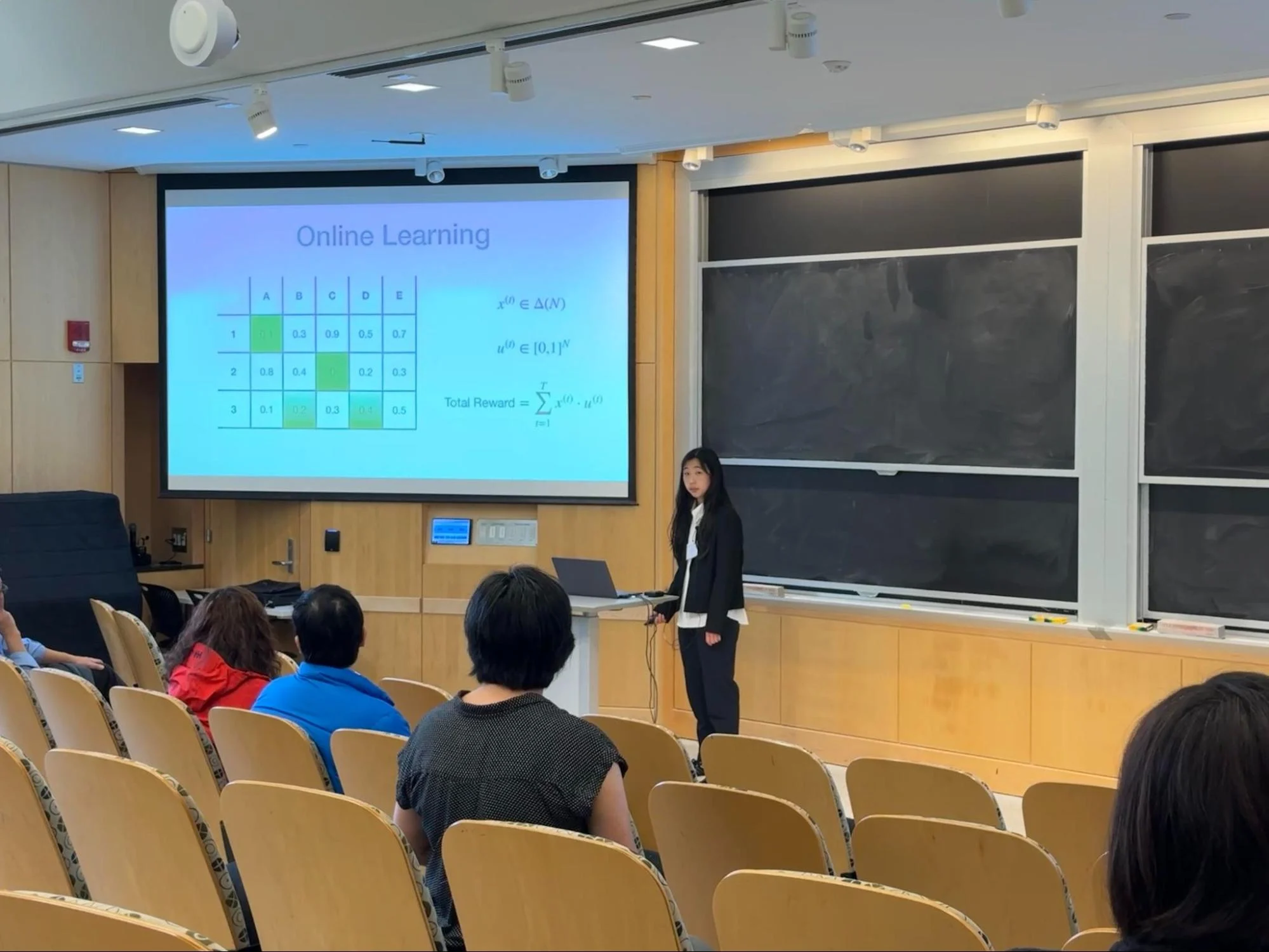
In addition to her archival work, Anisa visited historical sites across Boston, including the Museum of African American History, housed in the building that was once the 12th Baptist Church. She also walked the Black Heritage Trail, tracing the physical spaces connected to her studies. Her research culminated in a presentation at a Massachusetts Historical Society conference this November, where she shared her findings alongside other high school scholars studying Boston’s history.
The fellowship reshaped the way she thinks about history. “It’s made me think of history in a more place-based way—more spatially,” she says. “When I was initially applying for my fellowship, I had such a broad topic. Honing in on one place allowed me to trace deeper, more meaningful patterns.”
She credits Concord Academy with preparing her for the rigor of independent research: “The knowledge I learned of how to take good notes was pivotal to my research. CA’s encouragement of students to be self-sufficient, and to do work not just because they’re going to get a grade on it, but because they care about the thing they’re doing, was really important.”
Looking ahead, Anisa plans to major in history in college. “I definitely want to continue doing history,” she says. “You can’t do anything without history—everything comes from somewhere. I just think it’s such a universal discipline in a way that I really appreciate, and it will always be significant to me.”